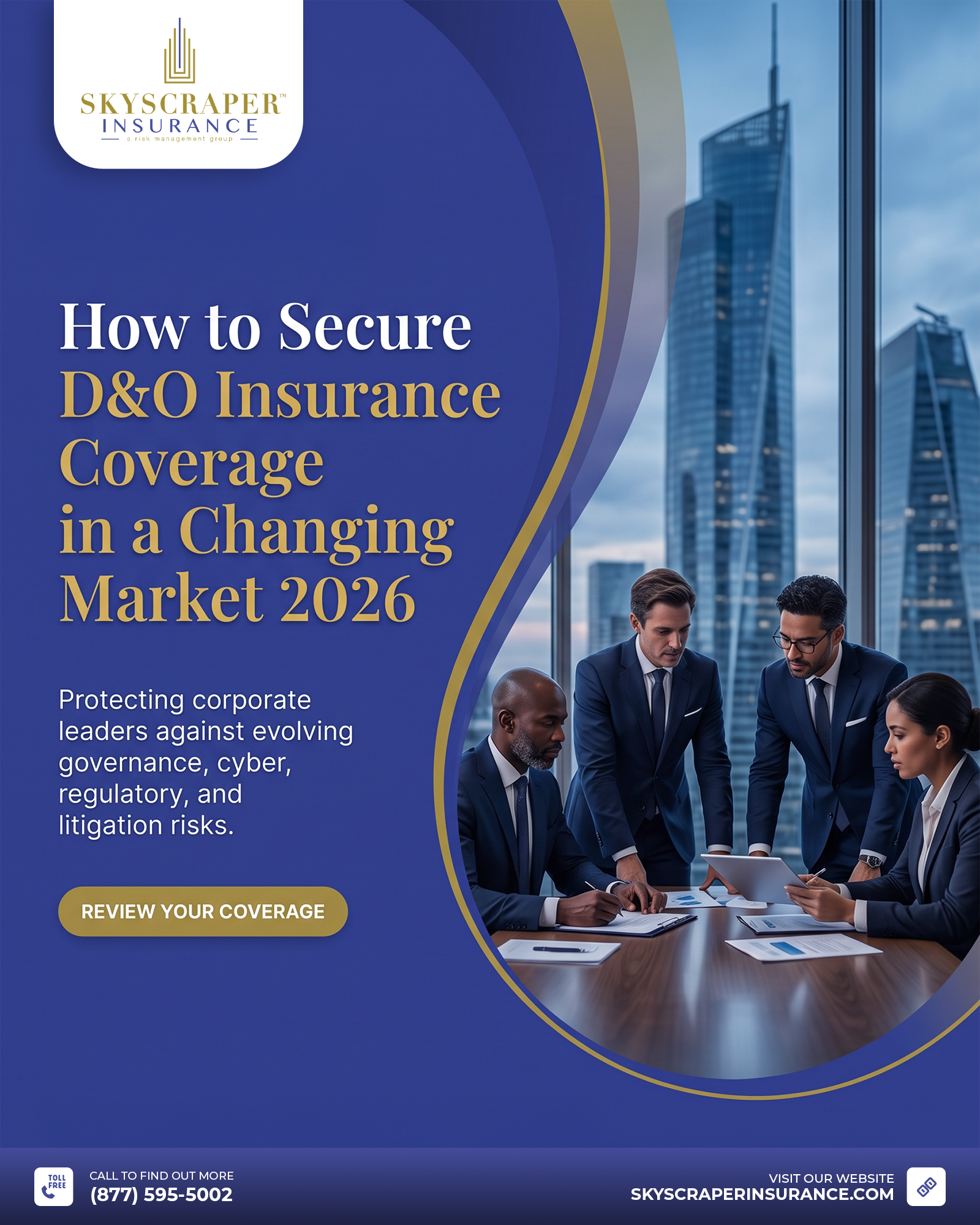
The Directors & Officers (D&O) liability insurance market has entered a rare phase of pricing stability. After an extended period of aggressive rate corrections followed by gradual buyer-friendly softening across primary and excess towers, corporate boards and financial officers are enjoying predictable renewal budgets and expanded carrier capacity.
Boardrooms are operating under an unprecedented convergence of regulatory scrutiny, emerging artificial intelligence governance liabilities, cyber incident fallout, and aggressive third-party litigation funding. When premium rates stabilize, carriers rarely compete by loosening policy language—instead, they quietly insert restrictive manuscript exclusions, raise retention floors for high-hazard sectors, and tighten excess attachment points.
At Skyscraper Insurance, we look past surface-level rate indices.
1. The Stability Paradox: Favorable Pricing vs. Escalating Severity
The current calm in D&O pricing is primarily driven by robust carrier capitalization, aggressive new market entrants, and heightened competition among excess underwriters looking to deploy capital.
Yet, while rate increases have flattened, claims severity continues to climb:
- Securities Class Actions & Regulatory Probes: Regulatory bodies continue to expand enforcement actions around corporate reporting, ESG statements, and technology governance. Even when investigations conclude without formal penalties, preliminary defense fees and forensic accounting costs quickly burn through primary limits.
- The “AI-Washing” and Cyber Vector: Shareholder derivative actions are increasingly tied to automated algorithmic bias, intellectual property claims, and data breach oversight. In an environment where operational disruptions trigger immediate stock drops, executive liability claims escalate rapidly.
2. Core Pillars of an Optimized D&O Strategy in a Stable Market
A stabilized pricing environment is the best time to negotiate broader terms, harmonize excess layers, and reinforce your executive protection architecture:
Side A Difference-in-Conditions (DIC) Dedication
Corporate indemnification can freeze overnight during restructuring, bankruptcy proceedings, or derivative settlements where company balance sheets are barred by law from indemnifying officers. A dedicated, standalone Side A DIC tower acts as an independent safety net, insulating the personal assets of directors and officers from bankruptcy courts and carrier disputes.
Excess Tower Synchronization & Exhaustion Alignment
Excess liability policies should follow the primary form as closely as possible. Conducting a forensic review of excess policy language ensures that secondary and tertiary layers recognize partial payment by policyholders, drop down immediately upon primary erosion, and do not introduce restrictive definitions that void coverage.
Harmonization of D&O and Cyber Responsibilities
As data security breaches increasingly trigger secondary shareholder lawsuits alleging breach of fiduciary duty, uncoordinated Cyber and D&O programs result in carriers pointing fingers over legal representation.
Market Perception vs. Modern Governance Realities
Review how a passive approach to stable D&O renewals contrasts with an active excess risk strategy:
| Governance Factor | The Passive Renewal View | The Skyscraper Excess Architecture | The Strategic Advantage |
| Pricing Strategy | Celebrate flat or modest premium cuts and roll over existing binders. | Leverage Market Capacity: Reinvest savings into expanded excess limits and broader manuscript terms. | Secures higher aggregate liability protection at historical baseline costs. |
| Excess Tower Terms | Assume excess layers automatically drop down and mirror the primary policy form. | Harmonized Exhaustion Wording: Eliminates strict “actual payment” traps and non-concurrent exclusions. | Guarantees seamless excess layer liquidity during multi-million-dollar settlements. |
| Insolvency Exposure | Rely solely on traditional corporate balance-sheet indemnification. | Ring-Fenced Side A DIC Layer: Dedicated individual limits untouchable by bankruptcy trustees. | Complete personal asset immunity for board members during severe corporate distress. |
| Emerging Tech Claims | Expect standard D&O forms to absorb AI disclosure and cyber oversight disputes. | Manuscripted Carve-Backs: Explicit representation coverage for AI governance and cyber claims. | Insulates leadership against regulatory enforcement and evolving tech exposures. |
Take Control: Review Excess Risk
Market stability is not an invitation to complacency—it is a window of strategic opportunity.
At Skyscraper Insurance, we specialize in executive risk engineering and management liability architecture. Our corporate risk advisors review your primary and excess policy language, test attachment points against emerging litigation trends, verify Side A DIC structures, and ensure your entire program is engineered to protect your leadership team under extreme litigation pressure.
Does your current D&O program take full advantage of market stability, or are your upper excess layers hiding critical coverage gaps?
Don’t wait for a securities lawsuit or regulatory subpoena to test how your excess policies respond. Take command of your executive protection today, connect with our management liability team, and Review Excess Risk. We will conduct a thorough forensic audit of your active program to maximize your terms, expand your limits, and insulate your leadership team.
Visit us at Skyscraper Insurance to schedule your executive risk review today.