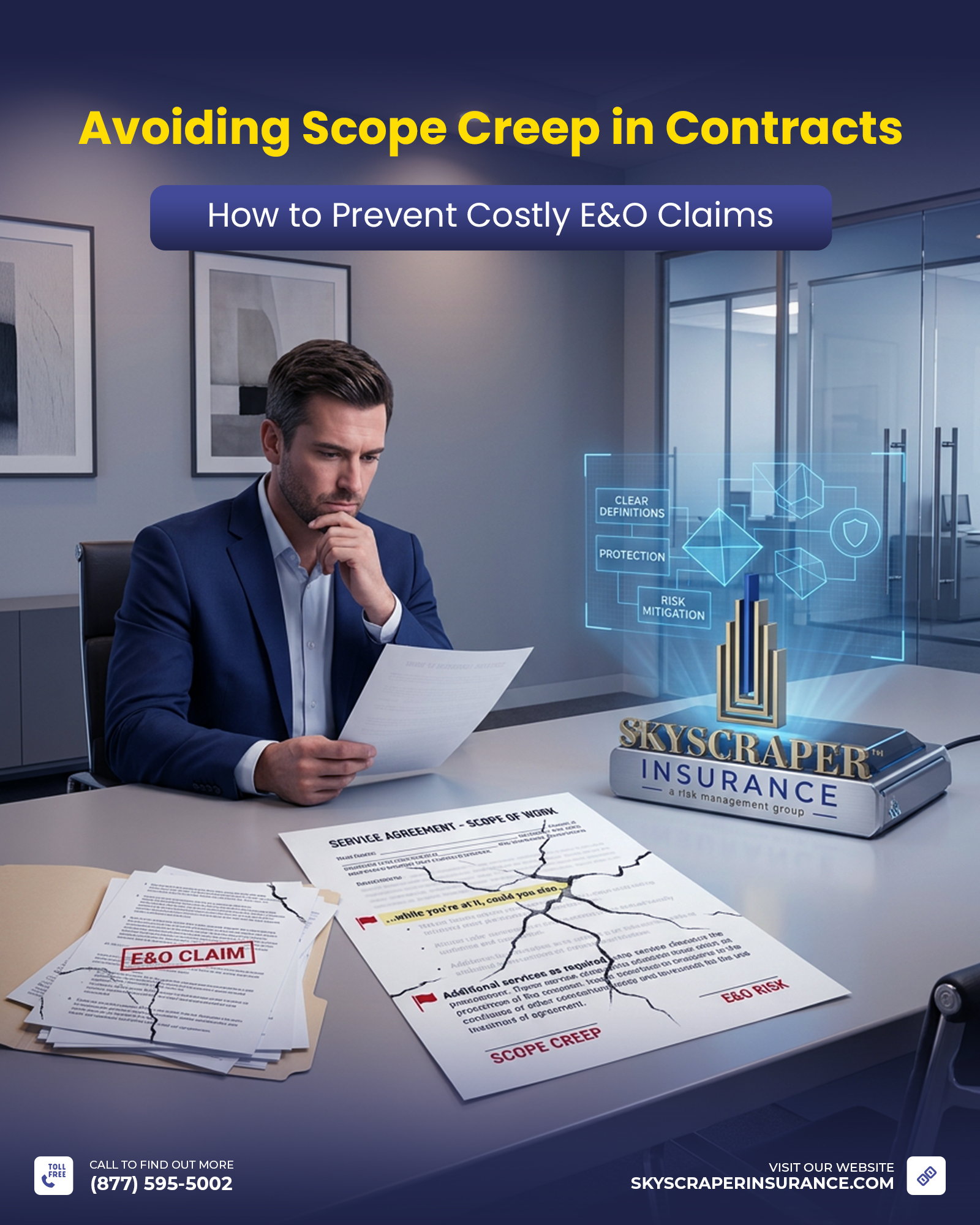
In the world of professional services—whether you’re a consultant, an architect, a software developer, or an accountant—the most dangerous phrase in the English language is: “While you’re at it, could you also just…?”
At Skyscraper Insurance, we call this Scope Creep. It’s the slow, silent expansion of a project’s requirements without a corresponding update to the written contract. While it often starts as a gesture of good faith to keep a client happy, it is one of the leading triggers for Errors & Omissions (E&O) claims in 2026.
If your work has moved beyond the “four corners” of your original agreement, you aren’t just working for free—you’re likely working without insurance. Here is how your contracts are triggering E&O losses and how to stop the bleed.
1. The Verbal Agreement Trap
Most Professional Liability policies are designed to cover your “Professional Services” as defined in your policy and your written contracts. When you perform a “quick favor” that falls outside that written scope, you are essentially self-insuring that task.
If that verbal addition goes wrong, the client won’t remember your “good faith.” They will remember the error. When the carrier reviews the claim and sees that the disputed work wasn’t part of the signed Statement of Work (SOW), they may have grounds to deny the claim, leaving you to pay for the defense and the settlement out of pocket.
2. Promising “Perfection” vs. “Standard of Care”
One of the most common “legal landmines” we see in professional contracts is the elevation of the Standard of Care.
Insurance is designed to cover Negligence—meaning you failed to perform to the level of a “reasonably prudent” peer in your industry. However, if your contract uses words like “highest professional standards,” “best-in-class,” or “guaranteed results,” you have moved from a negligence standard to a Contractual Guarantee.
Most E&O policies explicitly exclude “Contractual Liability.” If you are sued because you were “good” but not “perfect” (as promised in the contract), your insurance carrier may walk away, because “perfection” is not what they agreed to insure.
3. The Indemnification Domino
In 2026, we are seeing clients push for “Broad Form” indemnification clauses. These require you to pay for the client’s legal fees and losses even if you were only 1% at fault.
Because E&O insurance is fault-based, your policy will generally only pay for the portion of the loss you actually caused. If you sign a contract that makes you responsible for the whole pie, you are effectively on the hook for the remaining 99% of the judgment.
The Risk Matrix: Contractual vs. Insurable
To help your project managers triage new requests, review the comparison below:
| Feature | The Insurable Risk (Negligence) | The Uninsurable Risk (Scope Creep) |
| Trigger | Failing to meet industry standards. | Failing to meet a “guaranteed” result. |
| Documentation | Work defined in the signed SOW. | Work done via verbal request or email. |
| Standard | “Reasonably prudent” professional. | “Highest,” “Best,” or “Expert” standard. |
| Indemnity | Paying for your own mistakes. | Paying for the client’s mistakes/fees. |
| Policy Response | Full defense and settlement support. | Potential denial due to “Contractual Liability” exclusion. |
4. Why 2026 is Different: The “Economic Pressure” Claim
As we move through Q2, economic volatility is making clients more litigious. When a project goes over budget or fails to meet an ROI target, clients look for someone to blame. If you have “crept” outside your scope, you provide them with the perfect leverage. They can argue that your “extra” work distracted from the core mission, or that the extra work itself was the source of the failure.
Secure Your Practice with an E&O Gap Analysis
A “set it and forget it” Professional Liability policy is a myth. As your services evolve and your contracts become more complex, the gap between what you do and what you insure grows wider every day.
At Skyscraper Insurance, we specialize in forensic contract review. we don’t just look at your limits; we look at your Master Service Agreements (MSAs) to ensure your “Standard of Care” language hasn’t turned your policy into a useless piece of paper.
Are you working outside your safety net? Don’t wait for a “Request for Production” to find out your favors have become liabilities. Reach out to our expert advisors today to schedule a comprehensive E&O gap analysis. We will audit your current contracts, align your policy language, and ensure you can scale your services without scaling your exposure.