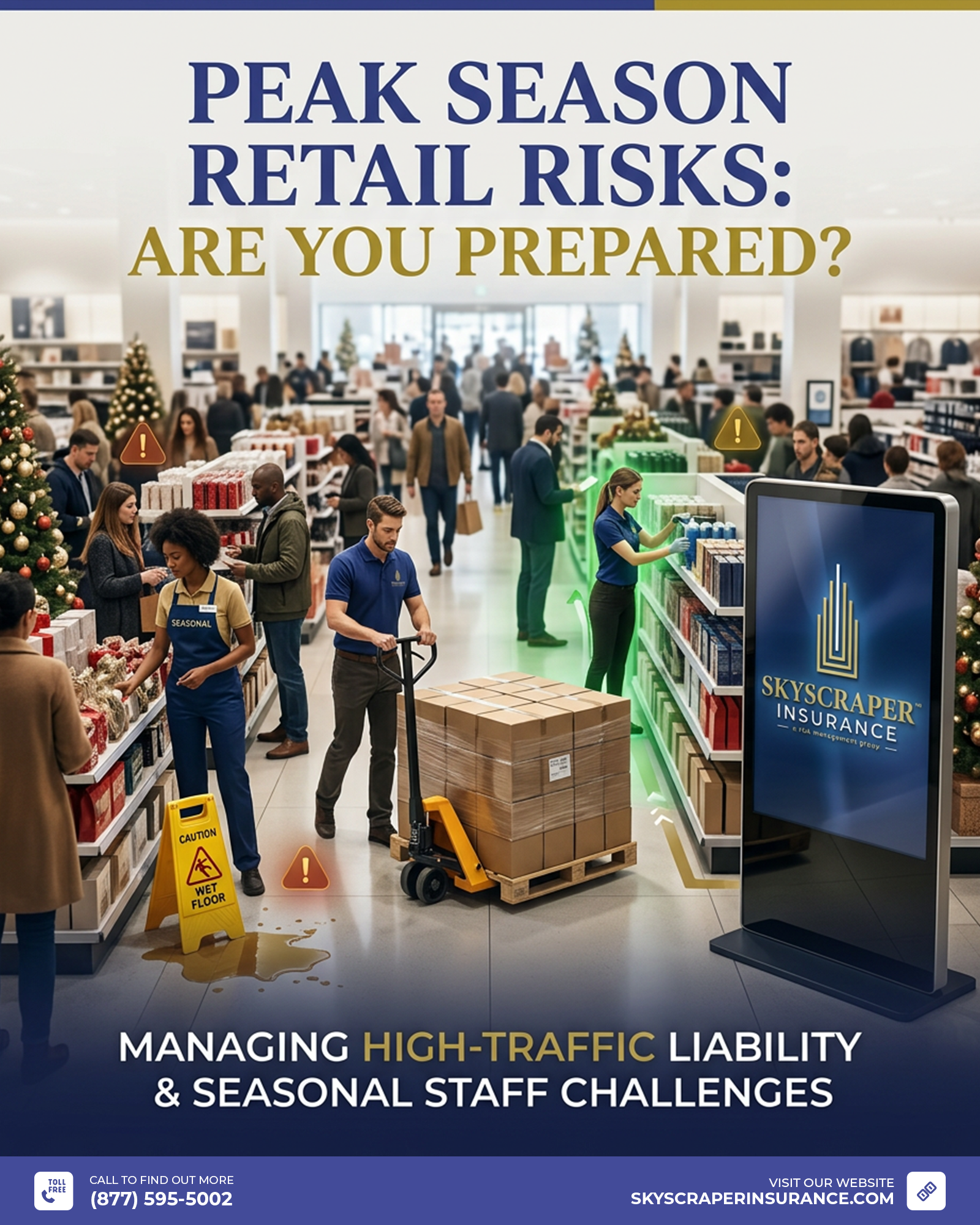
As the mid-year rush approaches, retail doors are swinging open faster than ever. Whether you are ramping up for summer tourism, outdoor pop-ups, or getting an early jump on peak inventory season, one operational reality remains constant: you need bodies on the floor, and you need them now.
At Skyscraper Insurance, we track retail claim trends year-round. When a business scales its workforce quickly using temporary, part-time, or seasonal employees, its risk profile changes overnight. The trend data is unmissable—claims don’t spike because retail sales increase; they spike because training gaps widen.
When an untrained seasonal employee drops a pallet, mismanages a spill, or mishandles a customer confrontation, the financial fallout doesn’t belong to the temp agency or the worker. It belongs entirely to your bottom line.
1. The Onboarding Rush and the Training Gap
In a high-velocity retail environment, onboarding often looks like a three-minute tour of the breakroom, a quick log-in demo for the Point of Sale (POS) system, and a swift “good luck out there.”
Safety protocols are frequently the first casualty of rapid hiring. Seasonal employees are rarely taught the fundamentals of loss control, such as:
- The 15-Minute Sweep: How to proactively scan aisles for tracking hazards, dropped inventory, or liquid spills.
- Improper Ergonomics: The correct way to lift heavy boxes from delivery trucks to avoid debilitating lower-back injuries.
- De-escalation Techniques: How to handle aggressive customers or suspected shoplifters without triggering a high-dollar assault or wrongful detention lawsuit.
If a seasonal worker watches a customer slip on a puddle of water, walks past it to grab a price tag, and another customer falls thirty seconds later, your business has established constructive notice. You had an employee on the scene who failed to act, completely dismantling your defense in a premises liability lawsuit.
2. Retail Claim Trends: What the Data Shows
Temporary staff are disproportionately involved in the two most expensive insurance claims in the retail sector:
Workers’ Compensation Claims
Seasonal workers are statistically more likely to get injured within their first 30 days than permanent staff are in an entire year. They lack familiarity with your specific stockroom layout, equipment (like heavy jacks or box cutters), and physical pacing. A single severe tear or fracture can skyrocket your Experience Modification Rate (E-Mod) for the next three years.
Third-Party General Liability
When seasonal staff are left unmonitored, customer injuries rise. Stocking shelves during operating hours without proper caution cones, blocking fire exits with overflow inventory boxes, and failing to secure overhead displays are classic “rookie” mistakes that lead to catastrophic injuries for shoppers.
The Seasonal Risk Matrix: Onboarding Gaps vs. Claims
To understand how a lack of structured training translates into an underwriter’s risk calculation, review the breakdown below:
| Operational Action | The Unmanaged Risk (The Training Gap) | The Insured Fallout (The Claim Trend) | The Preventative Standard |
| Stocking Stockrooms | Blocking electrical panels and fire sprinklers with seasonal overflow. | Property/Fire Claim: Carrier denial due to protective safeguard violations. | Enforce strict “clear zones” painted on the floor. |
| Spill Response | Leaving a wet floor unattended to go look for a mop. | General Liability: $50,000+ slip-and-fall settlement. | Station warning cones directly inside the retail aisles, not just in the back. |
| Inventory Unloading | Ignoring team-lift rules to hit a rapid unloading quota. | Workers’ Comp: Soft-tissue back injuries driving up your E-Mod. | Mandatory physical safety walk-through on Day One. |
| POS & Data Entry | Sharing register passwords or falling for basic phishing scams. | Cyber Liability: Ransomware attack via compromised hardware. | Individualized, restricted user profiles for all temporary accounts. |
3. The Myth of the “Temp Agency” Shield
Many retailers utilize staffing agencies to source seasonal labor, assuming the agency’s insurance policies shield the store from liability.
This is a dangerous legal misunderstanding.
While the staffing agency typically covers basic Workers’ Compensation for the employee’s payroll, your business provides the physical workspace, the tools, and the direct supervision. Under the legal doctrine of Respondeat Superior (and the “Borrowed Servant” principle), if that temporary worker causes harm to a customer or a vendor while under your watch, the lawsuit will target your General Liability policy—not the staffing agency’s.
Protect Your Margins: Schedule a Staffing Risk Check
Seasonal hiring should be an engine for growth, not a catalyst for litigation. Managing your retail risk isn’t about avoiding part-time labor; it’s about ensuring your insurance policy and your operational training match the speed of your business.
At Skyscraper Insurance, we don’t just hand you a policy and wish you a profitable quarter. Our specialized retail risk advisors work alongside your team to audit your onboarding protocols, evaluate your vendor agreements with third-party staffing agencies, and identify the hidden operational exposures that standard brokers miss.
Are your temporary workers protecting your seasonal profits, or are they quietly creating your next major claim?
Don’t wait for a peak-season incident report to find out where your training falls short. Reach out to our retail team today to execute a comprehensive Staffing risk check. We will stress-test your current safety guidelines, review your liability hand-offs, and ensure your business stays entirely protected through every seasonal surge.