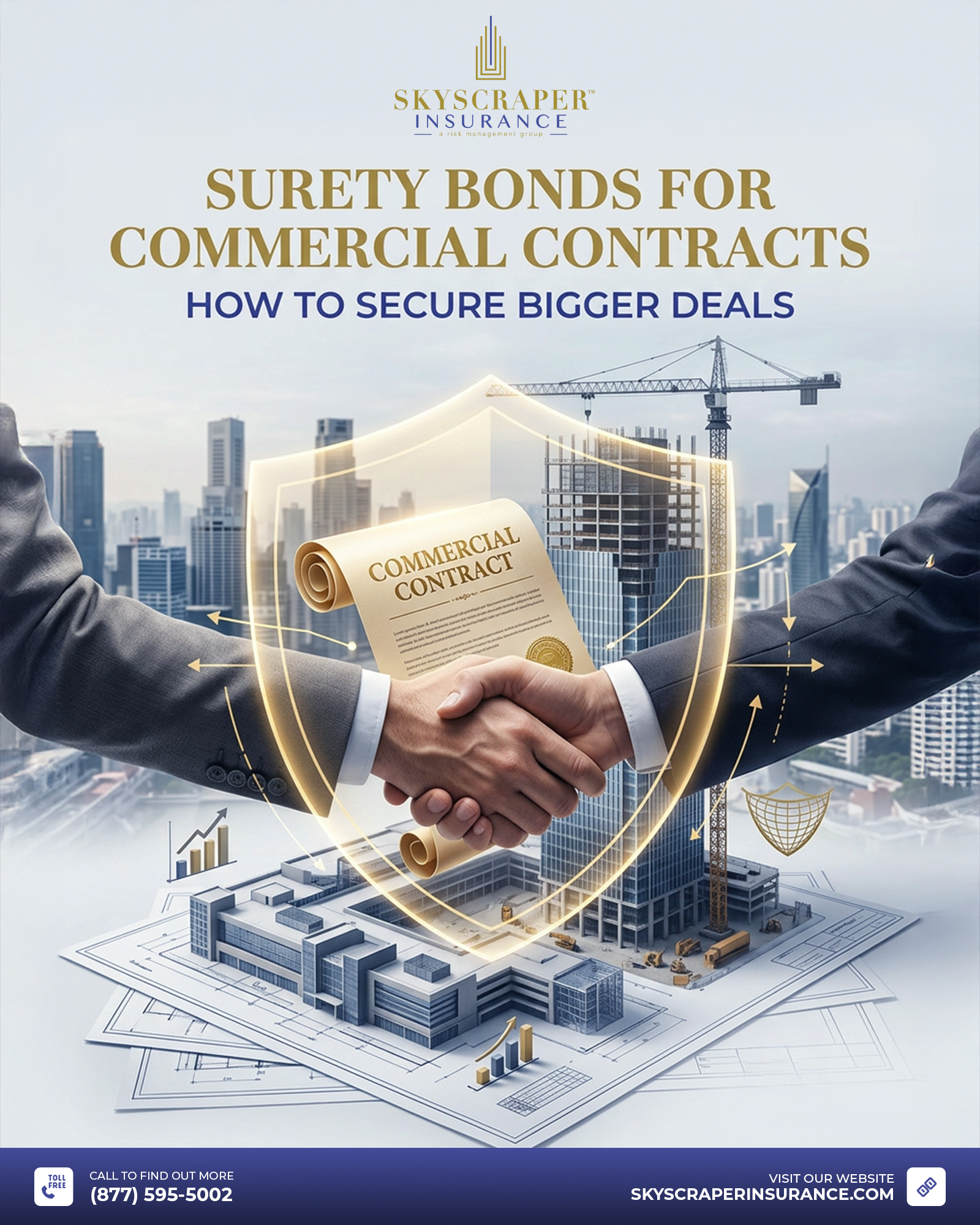
In the commercial world, a handshake is no longer enough to seal a deal. Whether you are a general contractor bidding on a multi-million dollar public infrastructure project, a developer looking to break ground on a commercial complex, or a business owner entering into a high-stakes vendor agreement, your partners need more than a resume. They need a guarantee.
When entering a new partnership, the entity hiring you (the obligee) faces a massive question mark: Will this company actually deliver on its promises, or will they default, leaving us with half-finished work and broken budgets?
If you cannot provide an ironclad corporate guarantee of your performance and financial liquidity, you will be locked out of the most lucrative contracts in your industry.
At Skyscraper Insurance, we understand that growth requires trust. You shouldn’t let a lack of corporate backing hold your business back from bidding on larger opportunities. True market confidence is built through strategic corporate underwriting. With a robust Surety Bond program in place, you provide your clients with absolute financial certainty, giving you the competitive edge to win bigger projects and scale your operations.
1. The Core Architecture: Insurance vs. Surety Bonds
Many business owners mistakenly view a surety bond as a traditional insurance policy. While both are critical risk-management tools, they operate on completely opposite financial principles.
Standard commercial insurance is a two-party agreement designed to protect your business from unexpected losses (like fire or theft). A surety bond, however, is a three-party financial instrument designed to protect your client from your potential failure to perform.
The Three-Party Relationship
- The Principal: Your business—the entity performing the work and purchasing the bond.
- The Obligee: Your client—the project owner or government entity requiring the financial guarantee.
- The Surety: The financial institution (backed by Skyscraper Insurance) that underwrites your capabilities and guarantees your performance to the obligee.
The Rule of Indemnity:
Unlike insurance, where a carrier absorbs a loss after a claim, a surety bond acts like a specialized line of credit. If your business defaults on a contract, the surety will step in to pay the obligee to fix the issue—but you (the principal) are legally required to indemnify the surety and repay every single dollar of that loss back to the financial institution.
2. The Pillars of Commercial and Contract Surety
To build a corporate bonding program that unlocks continuous commercial growth, you must understand the specific types of bonds required across different stages of a contract lifespan:
Bid Bonds
Before you can even submit a proposal for a major public or commercial contract, you often must provide a Bid Bond. This guarantees the project owner that your numbers are accurate, that you are bidding in good faith, and that if you win the contract, you will actually sign the agreement and provide the necessary final performance bonds.
Performance Bonds
The absolute bedrock of project execution. A Performance Bond guarantees that your business will complete the project strictly according to the terms, blueprints, timelines, and specifications detailed in the contract. If your operations suffer a sudden insolvency or labor shortage, the surety steps in to fund the completion of the project, protecting the owner from financial ruin.
Payment Bonds
A massive project involves an extensive supply chain of subcontractors, laborers, and material suppliers. A Payment Bond guarantees that you will pay all of your downstream vendors fully and on time. This insulates the project owner from costly mechanics’ liens being placed on their physical property by unpaid subcontractors.
The Surety Capacity Matrix: Contract Hurdles vs. Bonding Solutions
To help your executive team understand how targeted bonding solutions clear the path for your operations, review the alignment matrix below:
| The Commercial Hurdle | The Traditional Un-Bonded Reality | The Strategic Surety Solution | The Growth Advantage |
| Bidding on large-scale municipal or federal public works. | Disqualification. Government entities legally mandate bonding under the Miller Act. | Contract Surety Bond Line: Pre-approved aggregate bonding capacity tailored to your financials. | Market Access: Instantly opens the door to high-dollar, low-risk public revenue streams. |
| Securing municipal corporate operating licenses. | Stalled Operations. Cities refuse to issue business licenses without financial compliance. | Commercial License & Permit Bonds: Fast-tracked compliance bonds ensuring local statutory adherence. | Regulatory Freedom: Keeps your compliance framework legal and active across multiple regions. |
| Protecting a project owner from post-completion defects. | Withheld Funds. Clients hold back a massive percentage of your final retention payout. | Maintenance / Warranty Bonds: Guarantees structural integrity for 12 to 24 months post-close. | Cash Flow Optimization: Releases your final project cash flow instantly instead of letting it sit in escrow. |
3. Maximizing Your Bonding Capacity
Your ability to secure large surety bonds is dictated by your bonding capacity—the maximum dollar limit a surety company is willing to guarantee for a single project, as well as across all of your active projects combined (your aggregate line).
Surety underwriters evaluate your capacity using the classic Three Cs of Underwriting:
- Character: Your historical reputation, industry experience, and track record of successfully finishing projects.
- Capacity: Your operational strength—your equipment footprint, your key personnel, and your structural ability to perform the work.
- Capital: Your financial health—your balance sheet, working capital ratios, cash flow velocity, and overall corporate liquidity.
At Skyscraper Insurance, we don’t just pull financial credit scores. We act as your long-term advocate. We work closely with your accounting teams to structure your financial reporting, optimize your balance sheets, and aggressively negotiate with top-tier treasury-listed sureties to maximize your bonding lines, allowing your business to scale seamlessly.
Take Control: Learn More About Surety Bonds
In high-growth industries, your bonding line is your lifeline. Securing a strong surety relationship isn’t just about qualifying for your next project; it’s about building a foundation of financial credibility that signals to the entire market that your corporate assets are stable, your team is capable, and your execution is guaranteed.
At Skyscraper Insurance, our specialized surety advisors cut through the red tape of financial underwriting. We streamline your paperwork, fast-track your bond issuances, and engineer strategic capacity lines that match your corporate expansion targets without tying up your vital operating capital.
Is your current bonding line actively fueling your growth, or are you losing lucrative contracts to competitors with stronger corporate backing? Don’t let rigid underwriting requirements slow down your business pipeline. Reach out to our dedicated commercial advisory team today to learn more about surety bonds. We will stress-test your financial presentation, audit your operational track record, and build a customized bonding program that gives you absolute confidence in every single contract you sign.