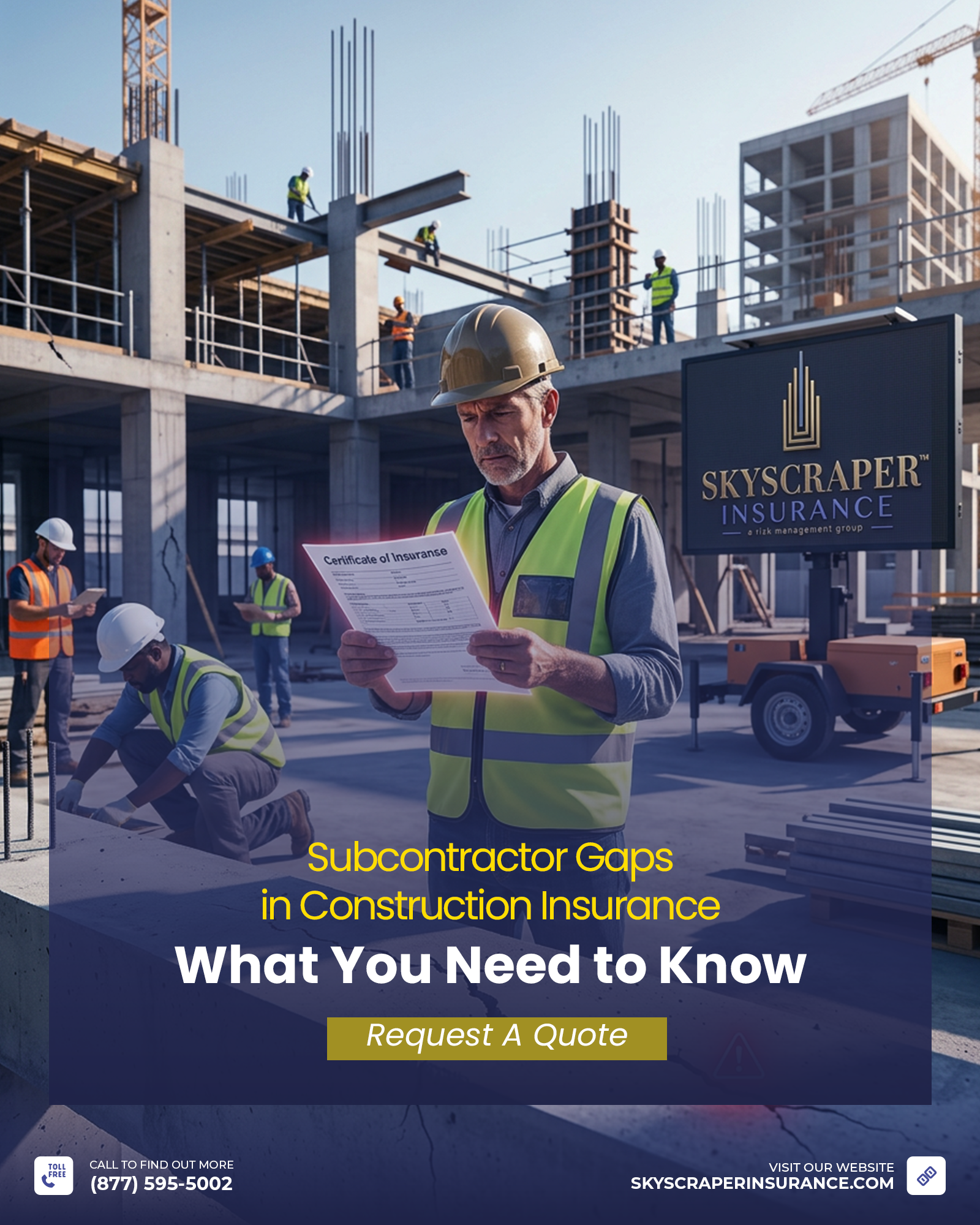
In the construction industry, the Certificate of Insurance (COI) is often treated as a “get out of jail free” card. You collect the paper, file it in a digital folder, and assume that if a sub-framer hits a water line or a laborer falls from a scaffold, the subcontractor’s policy will step in to catch the financial bullet.
At Skyscraper Insurance, we see the fallout when that assumption fails. In 2026, a COI is frequently a “paper tiger”, it looks intimidating and protective on your desk, but it provides zero actual defense when a million-dollar claim hits the fan. If you are relying on a standard COI without a deep-dive audit of the underlying policy, you are likely carrying the subcontractor’s risk on your own balance sheet.
Here is where the gaps live and why your current process might be failing you.
1. The “Snapshot” Problem
A COI is merely a snapshot of a policy at a specific moment in time. It proves the subcontractor had insurance at 10:00 AM on the day the agent hit “print.” It does not prove they have insurance today.
If a subcontractor fails to pay their premium and the policy is cancelled for non-payment thirty days later, the insurance carrier is under no legal obligation to notify you—even if you are listed as a “Certificate Holder.” You could be five months into a high-risk build with an uninsured crew on-site, and you wouldn’t know it until the first summons arrives.
2. The Exclusion Minefield
The COI shows you the “Limits of Liability,” but it doesn’t show you the Exclusions. This is the most common point of failure for General Contractors (GCs). Many low-cost subcontractor policies contain specific exclusions that render the policy useless for your specific job:
- Residential Exclusions: A sub might have a GL policy that explicitly excludes work on “multi-family dwellings” or “condos,” but they’re currently framing your 50-unit development.
- Height Exclusions: Some policies exclude any work performed above three stories—a catastrophic gap for NYC builds.
- Action Over / Labor Law Gaps: Especially in New York, policies often exclude “injury to employees,” which leaves the GC fully exposed to Labor Law 240/241 claims.
3. The “Additional Insured” Illusion
Checking the “Additional Insured” (AI) box on a COI is legally meaningless if the underlying policy doesn’t have the corresponding endorsement. Furthermore, not all AI endorsements are created equal.
Many policies use “Ongoing Operations” forms, which only protect you while the sub is physically on-site. The moment they pack up their tools, your protection vanishes. If a defect causes a fire or collapse six months after the project is finished, you have no access to their policy unless you mandated “Completed Operations” AI status in your contract.
COI vs. Policy Audit: The Reality Check
| Feature | What the COI Tells You | What a Subcontractor Audit Reveals |
| Policy Status | Active on the date issued. | Verification of current standing & “Notice of Cancellation” rights. |
| Scope of Work | General classification (e.g., “Carpentry”). | Detailed review for residential, height, or specific trade exclusions. |
| Additional Insured | A checked box. | Verifies the ISO form used (Ongoing vs. Completed Operations). |
| Primary/Non-Contributory | Usually a “Yes/No” check box. | Confirms the endorsement exists so your policy isn’t forced to pay first. |
| Limits of Liability | The face value (e.g., $1M/$2M). | Confirms if those limits have already been eroded by other claims this year. |
4. The “Primary and Non-Contributory” Oversight
Without this specific language, a claim can turn into a “battle of the forms.” Both your carrier and the subcontractor’s carrier will argue over who pays first. This creates a vacuum of defense, leading to mounting legal fees that you may have to pay out of pocket while the insurance companies fight it out in court.
Take Control Before the First Shovel Hits the Ground
In 2026, “trust but verify” is no longer a viable construction strategy. You need a proactive partner who doesn’t just collect COIs but “stress-tests” the subcontractor’s entire insurance program against your specific project requirements.
At Skyscraper Insurance, our risk advisors specialize in the forensic review of subcontractor policies. We identify the “Action Over” traps and the “Residential” exclusions before they can bankrupt your project.
Is your safety net made of paper or steel? Don’t wait for a catastrophic injury to find out your subs are effectively uninsured. Reach out to our expert construction team today to schedule a comprehensive Subcontractor audit. We will help you tighten your contracts, verify your endorsements, and ensure that your risk is truly transferred, not just deferred