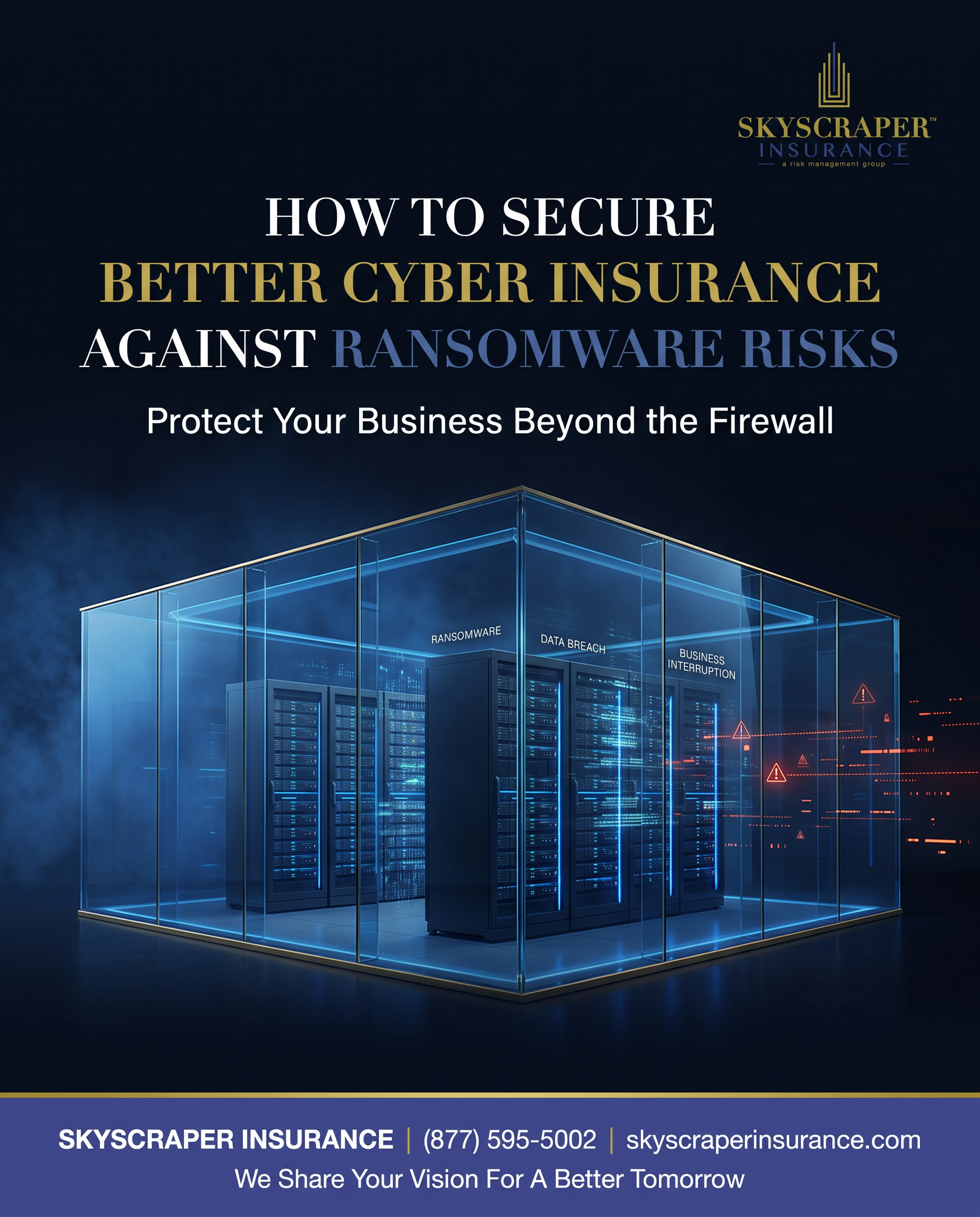
October marks the annual kickoff of Cybersecurity Awareness Month, bringing organizational focus to digital hygiene, threat detection, and system resilience. Across conference rooms and IT departments, businesses roll out multifactor authentication (MFA) audits, employee phishing simulations, and software patching protocols.
Yet, even the most sophisticated internal security defenses can still fail.
A single sophisticated phishing email, an unpatched third-party vendor vulnerability, or an AI-generated deepfake voice authorization can breach your perimeter in seconds. When an intrusion occurs, commercial enterprises quickly discover that technical controls alone cannot absorb the financial impact. True enterprise resilience requires connecting your daily operational IT security directly to a manuscripted Cyber Insurance architecture.
At Skyscraper Insurance, we look past check-the-box compliance. Modern digital defense requires treating cyber coverage not as a passive safety net, but as an active, integrated balance-sheet firewall.
1. The Shifting Cyber Threat Landscape Facing Commercial Enterprises
Cyber risk has evolved far beyond nuisance malware and localized data theft. Modern threat actors operate as well-capitalized syndicates targeting middle-market and enterprise cash flow:
- AI-Augmented Social Engineering & Deepfakes: Attackers increasingly use generative AI tools to clone executive voices, draft hyper-personalized spear-phishing campaigns, and bypass traditional email filtering. Wire transfer requests and payroll diversion schemes have grown exponentially harder for front-line employees to spot.
- Double & Triple Extortion Ransomware: Hackers no longer merely encrypt server backups; they exfiltrate sensitive proprietary data, threaten to release customer records publicly, and contact vendors or regulators directly to amplify negotiation leverage.
- Supply Chain & Vendor Interdependency: Most commercial enterprises rely heavily on cloud hosting, SaaS platforms, and managed service providers (MSPs). An outage or intrusion at a critical third-party vendor can halt your operations entirely—even if your physical network remains untouched.
- Aggressive Regulatory Penalties & Forensic Mandates: Data breaches trigger immediate scrutiny under state privacy laws, federal reporting guidelines, and industry-specific statutes like HIPAA. Forensic investigation retainers, mandatory client notification mailings, and statutory defense costs can quickly eclipse the cost of the ransom itself.
The False Sense of Security:
Many business owners believe strong IT defenses eliminate the need for comprehensive insurance. In reality, underwriters now require documented security controls, such as enterprise-wide phishing-resistant MFA, immutable offline backups, and Endpoint Detection and Response (EDR) just to issue a policy. When an unavoidable zero-day exploit strikes, standalone insurance provides the immediate capital needed to keep the doors open.
2. Technical Pillars of an Integrated Cyber Insurance Program
A complete commercial cyber risk architecture balances front-line incident response with back-end financial indemnification across four core pillars:
First-Party Breach Response & Forensic Containment
The first 48 hours following a network breach dictate the ultimate claim cost. First-party insuring agreements fund immediate access to pre-approved digital forensics firms, specialized privacy attorneys (breach coaches), public relations crisis consultants, and mandatory notification and credit-monitoring services for affected consumers.
Business Interruption & Dependent System Failure
System downtime is often the costliest component of a cyber event. This coverage reimburses lost net operating profit and ongoing payroll while your digital environment is locked down, remediated, or restored. Crucially, policies should include Dependent Business Interruption to cover lost revenue when an unowned third-party cloud or SaaS provider suffers an outage.
Cyber Extortion & Ransomware Negotiations
Navigating a ransomware incident requires strict adherence to legal compliance, including verifying that attackers are not sanctioned entities. Comprehensive policies provide access to professional ransomware negotiation teams, fund secure cryptocurrency settlement mechanics where legally permissible, and pay for data reconstruction and system restoration.
Social Engineering & Funds Transfer Fraud
Traditional property, casualty, and commercial crime binders routinely exclude voluntary transfer losses. Dedicated social engineering and invoice-manipulation endorsements protect cash reserves when an employee is deceived into wiring funds to an illegitimate fraudulent account.
Standalone Cyber Coverage vs. Commodity Insurance Endorsements
Review how an engineered standalone cyber policy outperforms standard package add-ons:
| Risk Touchpoint | Generic Property/CGL “Cyber Endorsement” | The Skyscraper Standalone Cyber Tower | Strategic Advantage |
| Coverage Limits | Sub-limited at nominal amounts ( | Full Dedicated Towers ( | Absorbs high-severity forensic, ransom, and class-action litigation costs. |
| Vendor Outages | Excluded; requires physical damage to your owned hardware. | Contingent & Dependent Business Interruption: Covers third-party cloud and SaaS failures. | Preserves operating cash flow even when disruptions originate off-premises. |
| Invoice Manipulation | Excluded under “voluntary parting of title” exclusions. | Manuscripted Funds Transfer Fraud: Affirmative coverage for fraudulent redirection. | Indemnifies wire losses caused by deepfake voice or email spoofing schemes. |
| Incident Response | Reimbursement-only model; policyholder must find and pay vendors upfront. | Day-Zero Breach Response Panel: Direct dispatch of vetted forensic and legal teams. | Halts data exfiltration quickly, mitigating secondary litigation liabilities. |
Take Control: Protect Your Data
Cybersecurity Awareness Month is a vital reminder to test your passwords, enforce multifactor authentication, and train your staff. But security awareness must be reinforced with balance-sheet defense. In an era of automated, AI-driven digital attacks, operational security and financial insurance must work together as one cohesive shield.
At Skyscraper Insurance, we act as the strategic bridge between your IT department and the global cyber underwriting market. We perform forensic audits of your current policy wording, identify unhedged digital liabilities, benchmark your security posture against carrier standards, and structure customized cyber towers that protect your revenue, reputation, and balance sheet.
Are your corporate assets, customer records, and operating revenues truly protected against a sophisticated breach, or is your business relying on outdated, sub-limited coverage?
Don’t wait for a ransom note on your servers or an unauthorized wire transfer to discover the limits of your coverage. Take command of your digital security as Cybersecurity Awareness Month kicks off, connect with our commercial risk advisors, and Protect Your Data. We will conduct a thorough, confidential review of your cyber exposures to ensure your business remains resilient against any digital threat.
Visit us at Skyscraper Insurance to schedule your cyber risk assessment today.