Structuring Bulletproof Business Income, Ordinance or Law, and Extended Indemnity Architectures for Apartment Portfolios
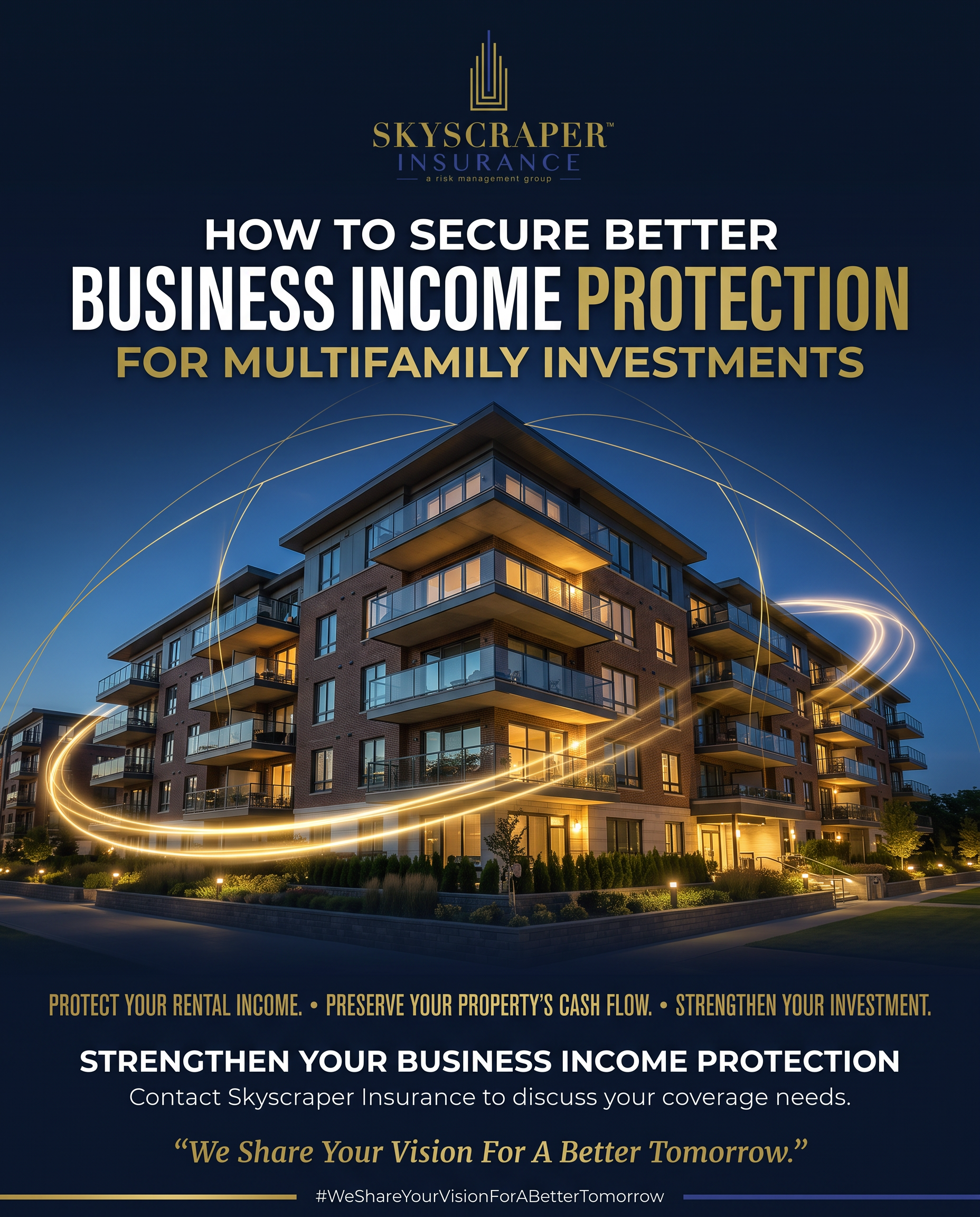
For multi-family real estate investors, syndicators, and institutional property operators, net operating income (NOI) is the engine that drives asset valuation, debt service coverage ratios (DSCR), and investor distributions. When a catastrophic property loss strikes an apartment community, a four-alarm kitchen fire, a burst main riser flooding thirty units, or a severe windstorm tearing off a roof, physical reconstruction is only half the financial battle.
The immediate threat to your capital stack is the sudden interruption of monthly rent collections while mortgage payments, property taxes, municipal assessments, and core site payroll continue uninterrupted.
This cash flow gap is where Loss of Rents (LOR), formally structured under commercial property policies as Business Income with Rental Value, is meant to respond. Yet, in multi-family claim settlements, Loss of Rents frequently underperforms.
When apartment owners rely on generic commercial package policies with uncalibrated limits, restrictive period-of-restoration definitions, and missing municipal code endorsements, carriers routinely cut off rental income payouts months before the building actually re-leases.
At Skyscraper Insurance, we engineer real estate risk programs around the operational realities of multi-family underwriting. Protecting your cash flow requires building a Loss of Rents architecture that mirrors true construction timelines, local building codes, and real-world lease-up velocity.
1. Where Standard Loss of Rents Coverage Fails Apartment Owners
Commercial property policies are drafted around strict time-element rules. In residential multi-family operations, three structural flaws regularly trigger severe cash flow shortfalls after a loss:
- The “Period of Restoration” Cliff: Standard ISO Business Income forms terminate rental income payments the exact day physical repairs are completed and a temporary Certificate of Occupancy is issued. However, an empty, newly repaired 150-unit apartment building does not generate cash flow overnight. Re-marketing units, screening applicants, and staggering move-ins can take six to twelve months. Without an Extended Period of Indemnity (EPI), your income stream stops while your occupancy sits at 0%.
- Municipal Code Delays (Ordinance or Law Time Element): Older garden-style and mid-rise apartment buildings rarely rebuild to pre-loss specifications. Municipal building departments routinely enforce modern fire-suppression sprinkler mandates, ADA elevator upgrades, and updated energy codes during major renovations. Standard Loss of Rents excludes the extra months required to engineer, permit, and construct code-mandated upgrades unless Ordinance or Law – Increased Period of Restoration (Coverage D) is actively endorsed.
- Co-Insurance and Monthly Limitation Traps: Policies written with a fixed dollar limit and an 80% or 100% co-insurance clause penalize owners if gross scheduled rents have grown faster than policy limits. Conversely, forms governed by a rigid 1/6 or 1/12 Monthly Limitation cap payouts per month regardless of seasonal leasing spikes or accelerated front-loaded expenses.
The Rent-Stabilized & Concessions Trap:
When calculating Loss of Rents limits, property managers often sum current collected net effective rents rather than gross potential rent plus tenant pass-throughs (utility bill-backs, parking fees, pet rent, and amenity charges). If a unit was vacant for routine turnover at the time of a fire, carriers may contest lost rental value unless the policy explicitly covers Fair Rental Value of Unoccupied Units scheduled for immediate lease-up.
2. Technical Pillars of an Engineered Loss of Rents Architecture
Fortifying your multi-family cash flow requires coordinating four specific policy mechanisms:
Actual Loss Sustained (ALS) Without Monthly Caps
Rather than guessing a static dollar limit that risks either overpaying premiums or triggering co-insurance penalties, structure your Loss of Rents on an Actual Loss Sustained (ALS) basis for 12, 18, or 24 months. ALS removes co-insurance clauses entirely and pays 100% of verified lost gross rental income and ancillary revenue streams for the duration of the restoration window.
Extended Period of Indemnity (180 to 365 Days)
Bridge the post-construction lease-up gap by attaching an Extended Period of Indemnity endorsement of at least 180 to 365 days. This ensures the insurer continues paying lost rental income after contractors hand back the keys, until occupancy and effective rent rolls return to pre-loss levels.
Ordinance or Law – Increased Period of Restoration
Pair your physical Ordinance or Law coverage (Coverages A, B, and C) with Time Element Coverage D. If updated municipal zoning, sprinkler retrofits, or environmental abatement add four months to your architectural and permitting timeline, Coverage D keeps your rental income checks flowing throughout the regulatory delay.
Off-Premises Utility Services & Ingress/Egress
If a municipal water main ruptures down the street or a regional electrical substation fails, rendering an apartment tower uninhabitable due to lack of water pressure, HVAC, or elevator service, standard Loss of Rents denies the claim because the building itself sustained no direct physical damage. Adding Utility Services – Time Element and broad Civil Authority endorsements protects cash flow during infrastructure failures.
Standard Commercial Package vs. The Skyscraper Multi-Family Standard
Review how an engineered Loss of Rents program insulates property NOI compared to a generic retail policy:
| Cash Flow Vector | Standard Retail Package Policy | The Skyscraper Multi-Family Architecture | Investor & Lender Advantage |
| Limit Structure | Fixed dollar limit with strict 80%/100% co-insurance penalties. | Actual Loss Sustained (ALS) – 18 to 24 Months: Zero co-insurance. | Guarantees full recovery of growing rent rolls and ancillary fee streams. |
| Post-Repair Lease-Up | Payments stop the day physical construction finishes. | Extended Period of Indemnity (180–365 Days): Covers lease-up ramp. | Sustains debt service and distributions until units are re-occupied. |
| Code Upgrade Delays | Excludes lost rent caused by municipal permitting or code retrofits. | Ordinance or Law Time Element (Coverage D): Full delay protection. | Absorbs the financial impact of sprinkler, ADA, and zoning mandates. |
| Infrastructure Outages | Excluded unless physical damage occurs directly on-site. | Off-Premises Utility & Civil Authority Endorsements: | Protects rental income during off-site power, water, or street closures. |
Take Control: Stress-Test Your LOR Coverage
In multi-family real estate, your property insurance policy is the primary guarantor of your debt service coverage and investor yield. Discovering after a fire or flood that your Loss of Rents coverage caps out at 12 months, excludes municipal code delays, or cuts off payments before a single tenant moves back in can force an unexpected capital call or loan default.
At Skyscraper Insurance, we specialize in multi-family real estate risk engineering, forensic policy audits, and institutional property placement. Our real estate advisors audit your current rent rolls, model worst-case reconstruction and lease-up timelines, eliminate co-insurance and monthly cap traps, and structure resilient Loss of Rents programs with premier national property underwriters.
Would your current Loss of Rents policy sustain your debt service and NOI through an 18-month rebuild and lease-up cycle, or would a hidden time-element restriction leave your capital stack exposed?
Verify your property’s cash flow resilience before a loss tests it for you. Connect with our real estate risk advisory team today to Stress-test your LOR coverage. We will perform a confidential audit of your active property forms and rent schedules to ensure your rental income is protected from day one through full stabilization.
Visit us at Skyscraper Insurance to schedule your multi-family Loss of Rents audit today.