Commercial Lines Satisfaction Drops 16 Points Across All Six Measured Dimensions as Independent Agents Push for Trust Over Price
The commercial insurance ecosystem runs on independent distribution. Independent insurance agents place the overwhelming majority of commercial property and casualty policies in the United States, serving as front-line advisors, technical risk managers, and advocates for policyholders.
Yet, according to the latest U.S. Independent Agent Satisfaction Study from J.D. Power, a widening divide has opened between the carriers underwriting commercial risks and the agents who distribute them.
Fewer than half of independent agents believe their commercial carriers treat them as true partners. Commercial lines satisfaction fell a sharp 16 points year-over-year, dropping across all six interaction dimensions measured by J.D. Power: risk appetite clarity, quoting and underwriting responsiveness, claims handling, policy servicing, communication quality, and product competitiveness.
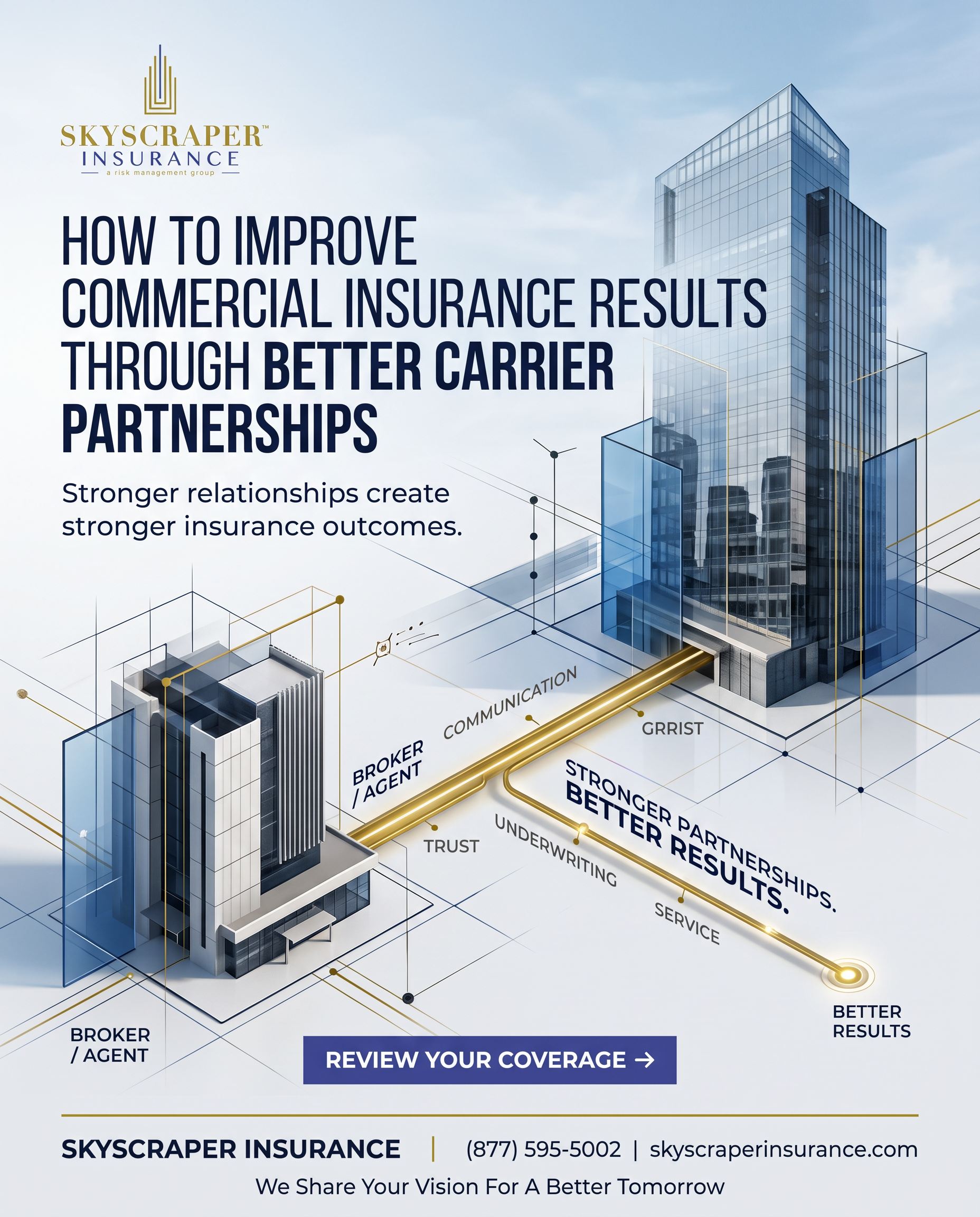
The message from the distribution force is unmistakable: independent agents and corporate risk advisors are no longer swayed by superficial carrier marketing or transactional, low-cost pricing. In an increasingly volatile risk landscape, commercial brokers demand trust, underwriting consistency, and true operational partnership.
At Skyscraper Insurance, this market dynamic confirms what our advisory philosophy has always held: when carriers view risk merely as commoditized premium transactions rather than collaborative relationships, commercial clients pay the price in missed coverage and disputed claims.
1. What the J.D. Power Findings Reveal
The deterioration in commercial lines satisfaction was neither localized nor isolated to a single friction point. The study reveals systemic friction across the carrier-distributor relationship:
- Trust and Innovation Outweigh Price: When independent agents were asked what defines a genuine partner-level carrier relationship, 76% cited trust and 50% cited innovation. Being the lowest-cost carrier ranked dead last at just 17%, trailing far behind operational factors. Price-driven commoditization is failing the distribution network.
- Underwriting Opacity & Shifting Appetites: Agents report mounting friction with ambiguous risk appetites and sluggish quoting turnarounds. When underwriters quietly restrict classes of business without clear guidelines, agents lose critical time and leverage during complex renewal windows.
- The Servicing & Claims Disconnect: The drop across claims handling and policy servicing highlights a persistent issue: automated portals and outsourced call centers have eroded the human touch required to resolve complex mid-term endorsements and commercial loss adjustments.
- Transactional Behavior Over Mutual Success: Agents are seeking carriers that understand the long-term health of their insureds’ balance sheets. When insurers treat renewals as automated mathematical rate bumps rather than risk-engineered negotiations, the partnership dissolves.
The Structural Takeaway:
A cheap quote is worthless if the carrier’s underwriting appetite evaporates at renewal, or if claims adjusters hide behind automated reservation-of-rights letters when a loss occurs. Real balance-sheet protection requires stable, high-trust carrier relationships.
2. Why Carrier “Partnership” Matters to the Policyholder
For commercial business owners, CFOs, and risk managers, carrier-agent friction is not an abstract industry statistic, it directly impacts corporate balance sheets:
Direct Access and Underwriting Clout
An advisory firm with deep, high-trust underwriter relationships can manuscript bespoke coverage endorsements, negotiate exceptions to standard policy exclusions, and advocate for favorable pricing credits. When a carrier treats an agent as a transactional vendor, negotiations default to rigid take-it-or-leave-it conditions.
Stability Through Market Cycles
Hard markets and casualty contractions test insurance arrangements. Carriers that view their brokers as strategic partners work collaboratively to structure higher deductibles, quota-share towers, or layered attachments rather than issuing sudden non-renewal notices 30 days before inception.
Aggressive Claims Advocacy
When a complex property or liability loss strikes, a broker’s relationship with senior carrier claims executives dictates the speed of resolution. True partnership allows for immediate peer-to-peer intervention to unblock delayed adjusters, adjust disputed reserves, and secure advance indemnification payments.
The Transactional Vendor vs. The Skyscraper Partnership Standard
Review how a consultative, high-trust carrier relationship contrasts with traditional commodity placement:
| Carrier Dimension | Commodity Transactional Model | The Skyscraper High-Trust Standard | The Client Advantage |
| Pricing Strategy | Focuses solely on lowest upfront premium. | Total Cost of Risk Optimization: Prioritizes coverage breadth, deductible sizing, and long-term stability. | Eliminates unexpected coverage denials and costly renewal spikes. |
| Underwriting Alignment | Passive submissions dropped into automated carrier portals. | Direct Underwriter Engagement: Technical risk engineering presentations and proactive meetings. | Unlocks manuscripted policy wording and preferred capacity layers. |
| Market Volatility | Scrambles when carrier risk appetites suddenly contract. | Multi-Carrier Strategic Alignment: Layered towers placed with vetted, committed syndicates. | Ensures program capacity remains intact through hardening cycles. |
| Claims Resolution | Relies on carrier customer service hotlines and automated portals. | In-House Claims Advocacy: Direct escalation to senior carrier claims leadership. | Accelerates First Notice of Loss actions and prevents claim leakage. |
Take Control: Review Coverage
The findings of the J.D. Power study prove what sophisticated risk managers have always understood: the insurance market cannot be navigated through price-comparison algorithms and detached, transactional relationships. When carriers do not collaborate with your advisors as trusted partners, your business is exposed to hidden vulnerabilities, delayed service, and adversarial claims handling.
At Skyscraper Insurance, we cultivate elite, high-trust partnerships with the world’s top commercial underwriters. We leverage our technical proficiency, forensic policy audits, and strong industry standing to advocate for our clients’ balance sheets, delivering uncompromised policy wording, preferred capacity, and hands-on claims advocacy.
Is your commercial insurance program backed by carriers that treat your advisory team as strategic partners, or is your business just another policy number in an automated system?
Demand more than off-the-shelf quotes. Partner with a risk advisory firm that commands respect and partnership from the carrier market. Connect with our commercial lines advisory team today and Review Coverage. We will conduct a comprehensive gap analysis of your active insurance towers to ensure your balance sheet is backed by underwriters you can trust.
Visit us at Skyscraper Insurance to schedule your commercial insurance review today.