Navigating Certificates of Insurance (COIs), Indemnity Clauses, and Common Contractual Traps Before Stepping on the Job Site
For small trade contractors, specialty builders, and growing construction firms, winning a commercial bid or securing a spot on a General Contractor’s (GC) preferred vendor list is a major growth milestone. Yet the moment the handshake is over, a dense Master Subcontractor Agreement (MSA) lands in your inbox, accompanied by a strict demand for a Certificate of Insurance (COI) before mobilization can begin.
Under pressure to lock in start dates and maintain cash flow, many small contractors forward the compliance sheet to their broker, generate a standard ACORD 25 certificate, and sign the contract without reading the fine print.
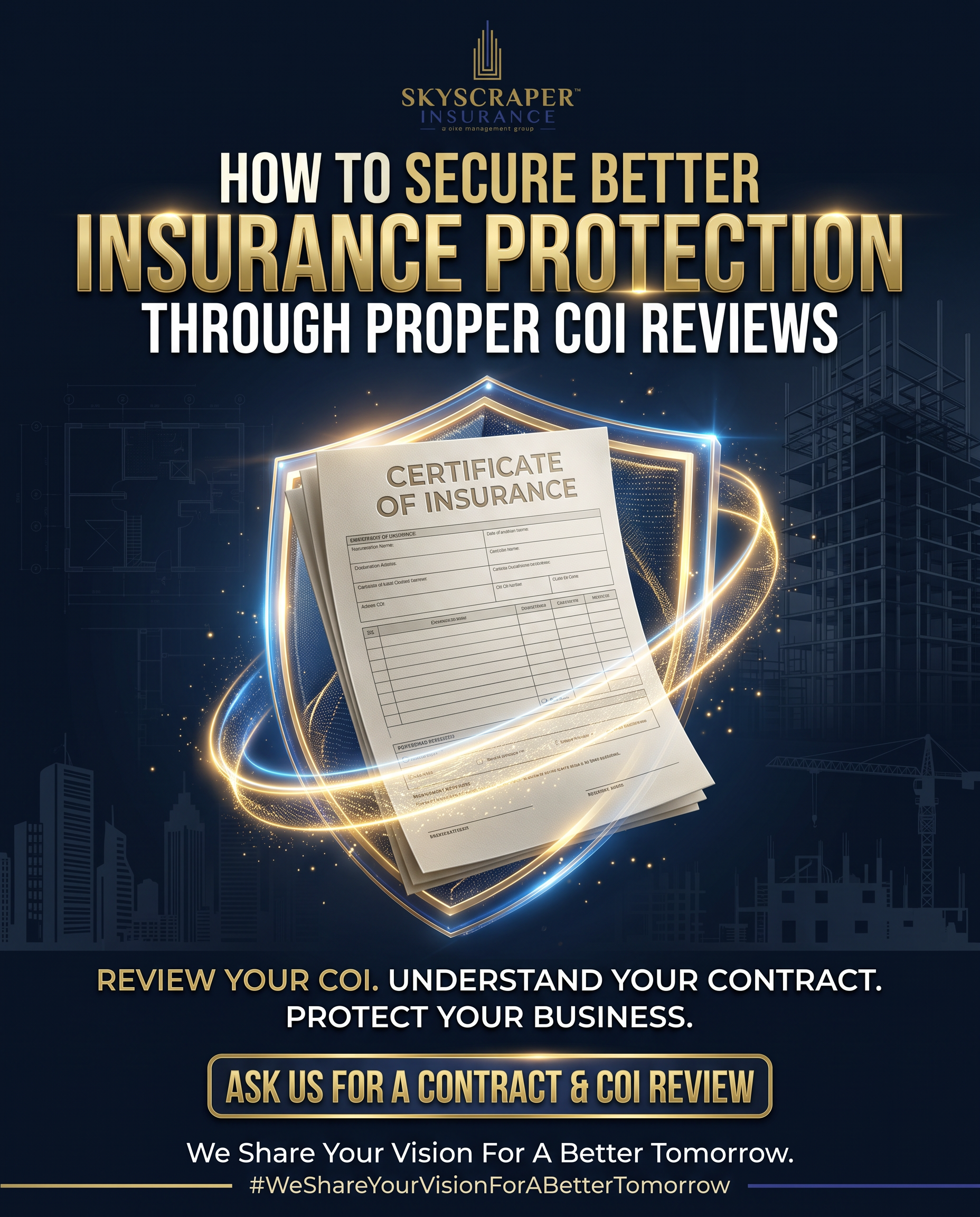
In construction risk management, that routine shortcut is one of the fastest ways to jeopardize a company’s balance sheet. A Certificate of Insurance is merely an informational snapshot—not an insurance policy. If the contract you signed promises broader liability protection than your underlying policy actually provides, you have just created an uninsured contractual liability gap that can wipe out your working capital in a single job-site dispute.
At Skyscraper Insurance, we treat construction contracts and insurance binders as interlocking engineering documents. Protecting your margins and equipment requires understanding how COIs, indemnity provisions, and endorsement mechanics interact before you sign on the dotted line.
1. The COI Illusion: Why the ACORD 25 Isn’t Enough
An ACORD 25 Certificate of Insurance proves only that specific policies were active on the date the document was issued. Across the top of every certificate, a legal disclaimer explicitly states that the document confers no rights upon the certificate holder and does not amend, extend, or alter policy coverage.
Relying solely on a basic certificate creates immediate friction during claims:
- Blanket vs. Scheduled Additional Insured (AI) Status: General Contractors almost always require Additional Insured status. If your Commercial General Liability (CGL) policy requires a written contract executed prior to a loss to trigger blanket AI coverage, and you mobilized before both parties countersigned the MSA, the GC has zero coverage under your policy, putting you in immediate breach of contract.
- Ongoing Operations vs. Completed Operations: Standard ISO endorsement CG 20 10 covers the GC only while you are actively working on-site (ongoing operations). However, construction defects and water intrusion claims frequently surface months or years after project completion. Without CG 20 37 (completed operations), your policy will not defend the GC post-completion, leaving your firm personally exposed to breach-of-contract lawsuits.
- Primary & Non-Contributory Wording: Without a specific Primary and Non-Contributory endorsement, your insurer and the GC’s insurer may enter protracted legal battles over whose policy pays first, stalling your final retainage payout and damaging key client relationships.
2. Decoding Indemnity Clauses and Hold-Harmless Agreements
Buried inside almost every construction contract is an Indemnification (Hold-Harmless) Clause. This provision dictates who absorbs the financial burden when property damage, bodily injury, or third-party lawsuits arise out of your scope of work.
- Broad Form Indemnity: Requires the subcontractor to indemnify the GC even if the loss was caused 100% by the General Contractor’s own sole negligence. While prohibited by anti-indemnity statutes in many jurisdictions, variations still appear in private commercial contracts, and standard CGL policies exclude sole-negligence transfers.
- Intermediate Form Indemnity: Requires you to absorb 100% of the loss if you were even 1% negligent alongside the GC. Even minor contributing fault can saddle your firm with the entire settlement burden.
- Limited (Comparative) Form Indemnity: The industry gold standard for fair risk allocation. Each party is held financially responsible strictly in proportion to their own degree of negligence.
The Waiver of Subrogation Trap:
Almost every commercial MSA mandates a Waiver of Subrogation across your CGL, Commercial Auto, and Workers’ Compensation policies. This prevents your insurer from suing the GC to recover claim payouts, even if the GC caused the accident. Issuing a COI showing a waiver when your underlying Workers’ Comp or Auto policy lacks a scheduled or blanket waiver endorsement is a technical misrepresentation that exposes your firm to direct reimbursement demands.
3. Four Common Coverage Mistakes That Derail Small Contractors
Even when a contractor carries standard 2M liability limits, hidden policy exclusions routinely void coverage on commercial sites:
- Overlooking “Action Over” / Labor Law Exclusions: In strict-liability states (such as New York’s Labor Law 240/241), injured subcontractor employees frequently sue the building owner or GC, who then tender the claim right back to your company under contractual indemnity. Many surplus lines CGL policies contain Employer’s Liability / Action Over exclusions that block coverage for injuries to your own workers, creating a catastrophic six- or seven-figure gap.
- Residential vs. Commercial Classification Mismatches: Taking on a commercial build-out while insured under a residential artisan policy, or vice versa, allows carriers to deny claims outright due to unendorsed operational classifications.
- Sub-Subcontractor (“1099”) Risk Leakage: Hiring uninsured independent helpers or day laborers without collecting valid COIs and executed subcontracts transfers their workplace injuries and workmanship defects directly onto your policies, and triggers steep premium surcharges during your year-end audit.
- Height, Roofing, and Exterior Restrictions: Standard artisan policies frequently carry rigid height caps (e.g., excluding work above two or three stories) or exterior envelope exclusions. Accepting a commercial facade or roof tie-in scope without clearing these restrictions leaves your crew completely uninsulated.
Commodity COI Issuance vs. The Skyscraper Construction Standard
| Compliance Dimension | Standard Retail Broker Approach | The Skyscraper Engineered Standard | Contractor Balance Sheet Advantage |
| Contract Alignment | Issues generic ACORD 25 without reading the underlying MSA. | Pre-Execution Contract Forensics: Audits indemnity and AI triggers before signing. | Eliminates uninsured contractual liability and prevents breach-of-contract defaults. |
| Additional Insured Scope | Basic ongoing operations (CG 20 10) only. | Combined Ongoing & Completed Ops (CG 20 10 + CG 20 37) + Primary/Non-Contributory: | Satisfies strict GC compliance audits and protects completed work years later. |
| Worker Injury Transfers | Unaudited surplus forms with hidden Action Over exclusions. | Affirmative Contractual Liability & Action Over Protection: | Insulates corporate equity from third-party-over employee injury lawsuits. |
| Sub-Tier Management | Informal tracking of 1099 helpers and trade subs. | Automated COI & Hold-Harmless Tracking Protocol: | Prevents audit surcharges and shields your Experience Mod from uninsured subs. |
Take Control: Ask Us for a Contract/COI Check
In commercial construction, your insurance program is only as strong as its alignment with the contracts you sign. Stepping onto a job site with a generic COI that contradicts your Master Subcontractor Agreement puts every dollar of profit, and your company’s survival—at risk.
At Skyscraper Insurance, we specialize in commercial construction risk engineering, subcontractor compliance, and casualty architecture. Our advisors review your MSAs line by line, flag toxic indemnity language, verify Additional Insured and Waiver of Subrogation endorsements, and structure resilient coverage towers with top-rated construction underwriters.
Are your insurance policies actually backing up the promises made in your construction contracts, or is a hidden exclusion waiting to turn your next project into an uninsured liability?
Protect your margins before your crew mobilizes. Connect with our construction advisory team today and Ask us for a contract/COI check. We will audit your active agreements and policy endorsements to ensure your compliance paperwork is rock-solid and your balance sheet is protected on every job site.
Visit us at Skyscraper Insurance to schedule your construction contract and COI review today.