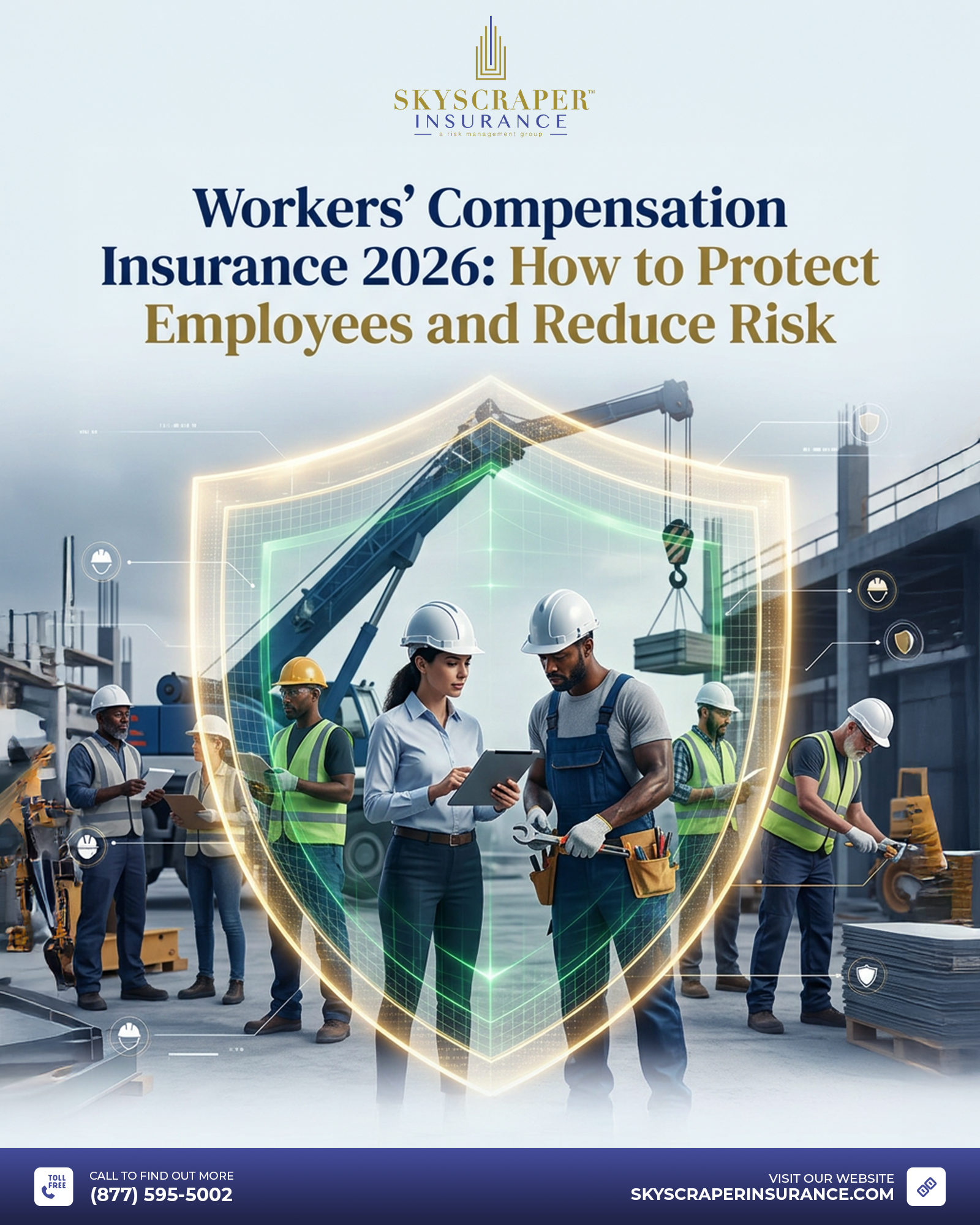
Your workforce is the engine that drives your business forward. Whether your team consists of skilled laborers operating heavy machinery on a manufacturing floor, field technicians driving between client sites, or software developers sitting at keyboards in a corporate office, your employees provide the specialized talent that turns your operational strategy into corporate revenue.
But humans are inherently vulnerable. No matter how meticulously you design your workplace safety protocols, accidents happen. A wet floor leading to a catastrophic slip-and-fall, a repetitive strain injury that develops over years of manual labor, or a multi-vehicle highway collision during a routine sales trip can halt your operations in an instant.
When an on-the-job injury occurs, the financial consequences can be staggering. Medical bills pile up, litigation threats loom, and your productivity plunges.
At Skyscraper Insurance, we look past basic payroll metrics to evaluate your true human capital risk. Managing a high-growth business in 2026 requires an ironclad, strategically designed Workers’ Compensation framework. When you structure this coverage correctly, you don’t just check a regulatory box—you secure your staff and build an unbreakable shield around your corporate assets.
1. The Legal Mandate vs. Capital Preservation
Virtually every state requires businesses with employees to carry Workers’ Compensation insurance. Operating without it isn’t just an administrative oversight; it is a severe statutory violation that carries heavy financial penalties, stop-work orders, and potential criminal liability for business owners.
However, viewing Workers’ Comp purely as a mandatory tax is a dangerous strategic mistake.
The real value of Workers’ Compensation lies in its role as an exclusive financial release valve for your business, operating under the legal doctrine of The Exclusive Remedy.
The Shield Against Litigation:
Under standard Workers’ Comp law, in exchange for providing guaranteed, no-fault medical and wage benefits to an injured employee, the employer receives statutory immunity from personal injury lawsuits stemming from workplace accidents.
Without this policy firmly in place, a single severe workplace injury could result in a multi-million dollar negligence lawsuit targeting your corporate balance sheet, exposing your personal savings, and devastating your business continuity.
2. Deciphering the Blueprint: How Workers’ Comp Works
Smart corporate protection means understanding how a standard Workers’ Compensation policy splits into two distinct, highly critical parts to defend your organization:
Part One: Workers’ Compensation Benefits
This section handles the no-fault statutory benefits owed to your injured employee. It provides unlimited coverage for all necessary medical treatments, prescription drugs, surgeries, and physical rehabilitation. Furthermore, it pays disability benefits—typically calculated as a percentage of the worker’s average weekly wage—to keep their household afloat while they are physically unable to work.
Part Two: Employers’ Liability Insurance
While Part One protects your workers, Part Two explicitly protects you. If an injured employee’s family decides to sue your business for loss of consortium, or if a third party dragged into the incident files a lawsuit claiming your negligence caused the damage, Employers’ Liability covers your legal defense costs, settlements, and court-awarded damages. In an era of escalating corporate litigation, having robust Employers’ Liability limits is non-negotiable.
The Workforce Protection Matrix: Operational Risks vs. Insurance Reality
To help your human resources and operations teams evaluate your current risk profile, review the comparison below of common workplace hazards and the necessary policy structures:
| The Workplace Accident | The Un-Audited Risk Reality | The Optimized Skyscraper Solution | The Strategic Advantage |
| An employee slips on an unmarked wet surface in your warehouse. | Skyrocketing Claims Costs. Poor claims management allows the file to drag out for months. | Early Intervention Protocol: Immediate triage routing to preferred medical networks. | Cost Control: Cuts medical inflation and gets the worker back to work quickly. |
| Misclassified workers lead to massive premium audits. | Financial Penalties. The carrier hits you with huge out-of-pocket payroll adjustment bills. | Forensic Class Code Auditing: Direct alignment of staff duties with correct NCCI classification codes. | Capital Preservation: Ensures you pay exact premiums without wasting dollars on incorrect risk tiers. |
| A remote worker develops severe carpal tunnel syndrome at home. | Denied or Stalled Claim. Lack of remote-work policy language leads to bitter litigation. | Telecommuting Endorsements: Explicit policy language mapping out remote work footprints. | Modern Liability Defense: Insulates the business from modern, decentralized operational risks. |
| An executive is injured while visiting an international vendor site. | Coverage Gap. Standard local policies explicitly exclude out-of-country workplace injuries. | Foreign Voluntary Workers’ Compensation: Extends baseline medical and wage benefits globally. | Global Mobility Security: Keeps your leadership protected through any international corporate travel. |
3. Mastering Your Experience Modification Factor (Mod Rate)
Your Workers’ Comp premium isn’t an arbitrary number determined entirely by the market. It is heavily dictated by your business’s individual claims history, tracked through a metric known as your Experience Modification Rate (Mod Rate).
A baseline Mod Rate is set at 1.0. If your business has a clean safety record with fewer claims than the industry average, your Mod Rate drops below 1.0 (e.g., 0.85), giving you a direct premium discount. Conversely, if your workplace suffers frequent, unmanaged accidents, your Mod Rate spikes above 1.0 (e.g., 1.35), acting as a massive premium penalty that drains your operating capital year after year.
At Skyscraper Insurance, we don’t just sell you a policy and walk away. We practice active Mod Rate engineering. We review your historical loss runs, implement aggressive return-to-work programs, and optimize your safety metrics so you can consistently drive your premiums down.
Take Control: Check Your Workers’ Comp Coverage
A chaotic workplace accident shouldn’t be the moment you discover your class codes are wrong or your liability limits are deficient. Managing your human capital risk isn’t about cross-checking your fingers and hoping no one gets hurt; it’s about engineering your insurance policies so they respond flawlessly the exact second a crisis occurs.
At Skyscraper Insurance, we provide forensic policy auditing for your workforce. We look past the top-line numbers on your declaration page to find the hidden exclusions, payroll misclassifications, and rating errors that dictate your financial survival. We help you secure optimized coverage structures that protect your staff while maximizing your bottom-line efficiency.
Are your corporate assets entirely bulletproof, or are you one workplace injury away from a devastating audit penalty or lawsuit?
Don’t wait for an incident report to land on your desk to read the fine print. Reach out to our specialized commercial advisory team today and say, “Check your workers’ comp coverage.” We will stress-test your current safety metrics, audit your class codes, and ensure your business cash flow remains secure through every operational shift ahead.