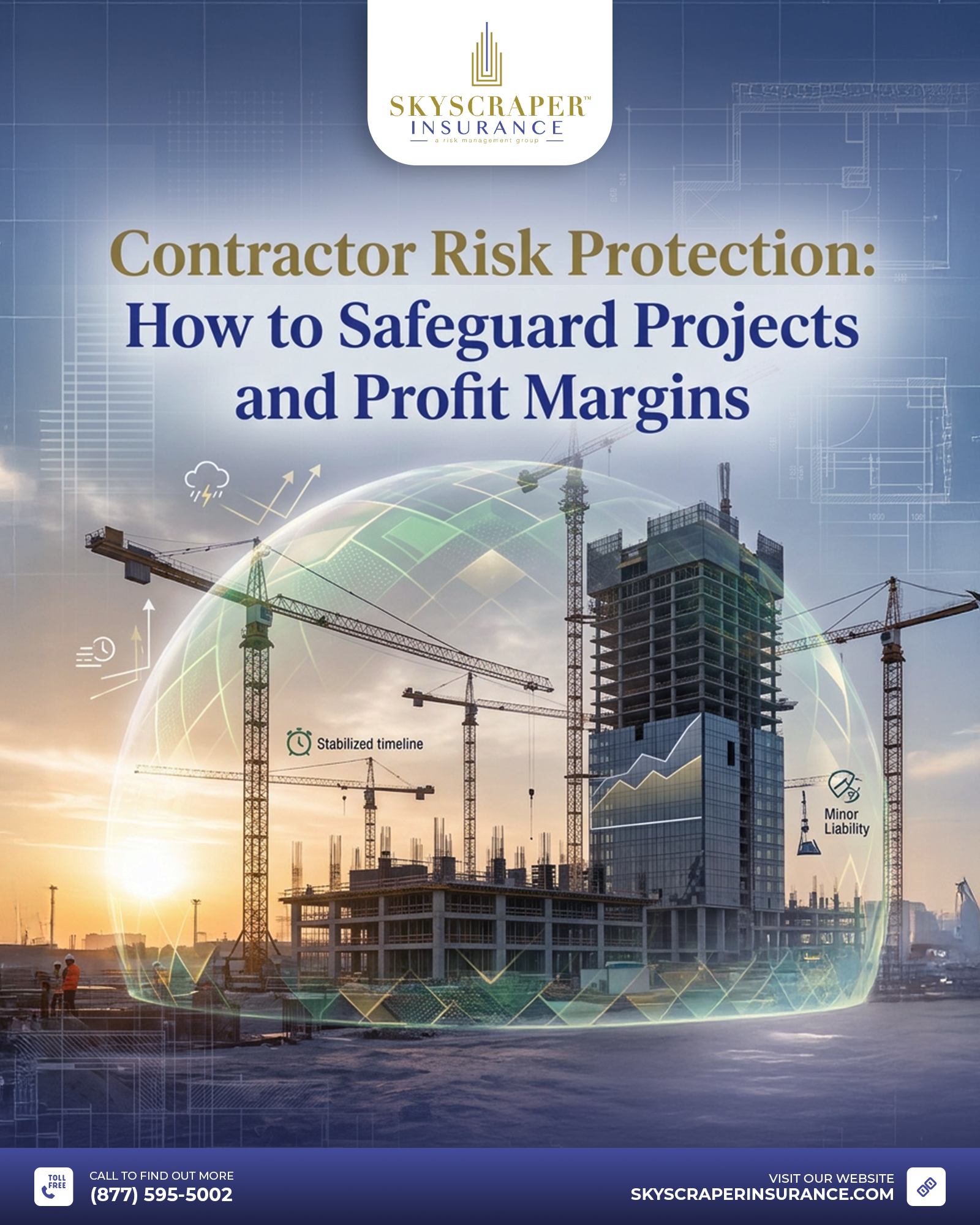
In the construction sector, your business builds the literal infrastructure of our world. Whether your firm is breaking ground on a multi-family residential development, pouring the concrete foundations for a suburban commercial center, retrofitting a historic industrial warehouse, or executing highly specialized mechanical contracts, your operations drive tangible economic growth.
But a construction site is one of the most volatile and physically exposed operational environments in the modern business landscape.
Every single day, your projects face a complex matrix of shifting liabilities: unpredictable weather delays, volatile material costs, hazardous labor conditions, design deviations, and complex subcontractor networks. A single rigging failure during a heavy crane lift, a subsurface water pipe puncture during excavation, a devastating fire on a half-completed structure, or a post-closing construction defect lawsuit can halt your project velocity and erase your profit margins instantly.
Far too many general contractors and developers view construction insurance as an annoying administrative hurdle—a collection of disjointed certificates compiled simply to satisfy a project owner or a municipal lender. But in today’s high-stakes regulatory and litigation climate, an un-coordinated insurance program is a structural flaw.
At Skyscraper Insurance, we cut through the confusing jargon and fragmented paperwork to deliver clear, forensic protection. We know that high-performing contractors require a unified asset shield that matches the scale of their blueprints. We are here to make your risk management as precise as your engineering: this is construction risk, simplified.
1. The Half-Built Asset: Navigating Builder’s Risk and Valuation Volatility
The single most dangerous insurance mistake made during a project lifecycle is assuming that a standard commercial property policy will cover a building under construction. Traditional property insurance is designed exclusively for completed structures. The moment you clear land, dig trenches, or erect temporary scaffolding, you enter a highly specialized risk zone that requires a dedicated Builder’s Risk policy.
Builder’s Risk acts as a financial shield over your project’s physical materials, temporary structures, and the growing building itself. However, in 2026’s economic environment, building an asset over a 12-to-24-month timeline introduces massive exposure to fluctuating raw material prices and supply chain delays.
Soft Costs vs. Hard Costs:
If a severe storm or arson fire destroys a project when it is 60% complete, a basic policy only pays for the “hard costs”—the physical lumber, steel, and concrete required to rebuild.
A sophisticated construction risk program must explicitly include Soft Costs Coverage. This extension steps in to fund the devastating financial consequences of a project delay, reimbursing your firm for ongoing construction loan interest, real estate taxes, architectural re-design fees, legal expenses, and extended security costs while the site sits stagnant during a rebuild.
2. The Core Pillars of Contractual Protection
To construct an ironclad corporate framework that allows your business to bid on higher-dollar projects, your insurance architecture must rely on four critical pillars:
Wrap-Up Insurance (OCIP or CCIP)
On a massive job site utilizing dozens of independent subcontractors, traditional insurance leads to fragmented coverage and finger-pointing when a claim occurs. A Wrap-Up Insurance Program—either an Owner-Controlled (OCIP) or Contractor-Controlled (CCIP) Insurance Program—unifies the General Liability and Workers’ Compensation for all contractors and subcontractors under a single, master policy. This eliminates costly coverage cross-suits, slashes aggregate premium volumes, and ensures absolute consistency in liability limits across the entire site.
Commercial General Liability with Completed Operations
A contractor’s liability doesn’t stop when they pack up their tools and hand over the keys. If a structural weld fails, a roof leaks, or a faulty electrical connection triggers a fire months or even years after project completion, your business can face multi-million dollar construction defect lawsuits. Completed Operations coverage is the vital lifeline that stays active post-project, shielding your corporate balance sheet from lagging litigation.
Contractors Pollution Liability (CPL)
Standard commercial general liability explicitly excludes environmental damage. If your excavation crew accidentally breaches an underground storage tank, disrupts a vein of naturally occurring asbestos, or causes a silt runoff that contaminates a local waterway, your business faces catastrophic cleanup costs and statutory fines. A dedicated Contractors Pollution Liability policy buys back this protection, covering emergency remediation expenses and third-party bodily injury claims.
The Construction Resilience Matrix: Project Hazards vs. Risk Engineering
To help your project managers and executive team stress-test your current coverage layout before your next mobilization date, review our operational alignment matrix:
| The Construction Hazard | The Un-Audited Risk Reality | The Optimized Skyscraper Shield | The Strategic Advantage |
| A sub-tier contractor causes a severe third-party property damage incident. | Total Exposure. The subcontractor’s policy has lapsed, dragging your firm into primary liability. | Rigid Subcontractor Insurance Tracking & AI-Driven Auditing: Enforces strict, automated verification of compliance certificates. | Risk Indemnification: Contractually pushes primary liability back to the responsible party, insulating your loss history. |
| High-value copper pipe and specialized HVAC units are stolen from the job site overnight. | Denied. Standard policies exclude materials stored off-site or transit thefts. | Inland Marine & Installation Floater: Covers materials from the warehouse, through transit, to the exact moment of installation. | Supply Chain Security: Safeguards your working capital from equipment theft and logistical damage. |
| An earth-moving excavator experiences a sudden, catastrophic engine fire. | Stalled Velocity. Replacing heavy iron out of pocket triggers severe project delays. | Commercial Heavy Equipment / Inland Marine Schedule: Provides full replacement value for specialized mobile machinery. | Fleet Continuity: Gets your operators back in the cabs quickly without draining your corporate cash reserves. |
| A design professional alters a blueprint, causing an ongoing foundation settlement issue. | The Exclusions Maze. Standard general liability completely denies claims tied to professional errors. | Contractors Professional Liability (PrL) Endorsement: Bridges the gap between construction execution and engineering advice. | Errors & Omissions Shield: Insulates design-build firms from devastating professional liability and design flaws. |
Take Control: Talk to Our Construction Experts
You wouldn’t execute a complex project build without reviewing the structural engineering blueprints first. Your insurance portfolio deserves that exact same level of forensic design. In today’s construction climate, navigating risk isn’t about collecting certificates or buying the cheapest policy per square foot; it’s about actively engineering your risk so that your corporate equity, your profit margins, and your crew are bulletproof through every phase of the project lifecycle.
At Skyscraper Insurance, we are built to handle the heavy lifting. We don’t deal in generic policies or automated call centers. Our dedicated construction risk advisors speak your language. We analyze your prime contracts, write precise indemnity agreements, structure optimized wrap-ups, and negotiate customized limits with top-tier, A-rated national sureties and insurance carriers.
Are your corporate assets completely insulated across your active projects, or are you one sub-tier default or job site incident away from a devastating loss?
Don’t wait for a formal claim notice to land on your job site trailer to find the gaps in your coverage. Take command of your operational security today, reach out to our dedicated advisory team, and say, “Talk to our construction experts.” We will run a complete forensic audit of your active policies, maximize your premium efficiency, and ensure your business remains built to last.