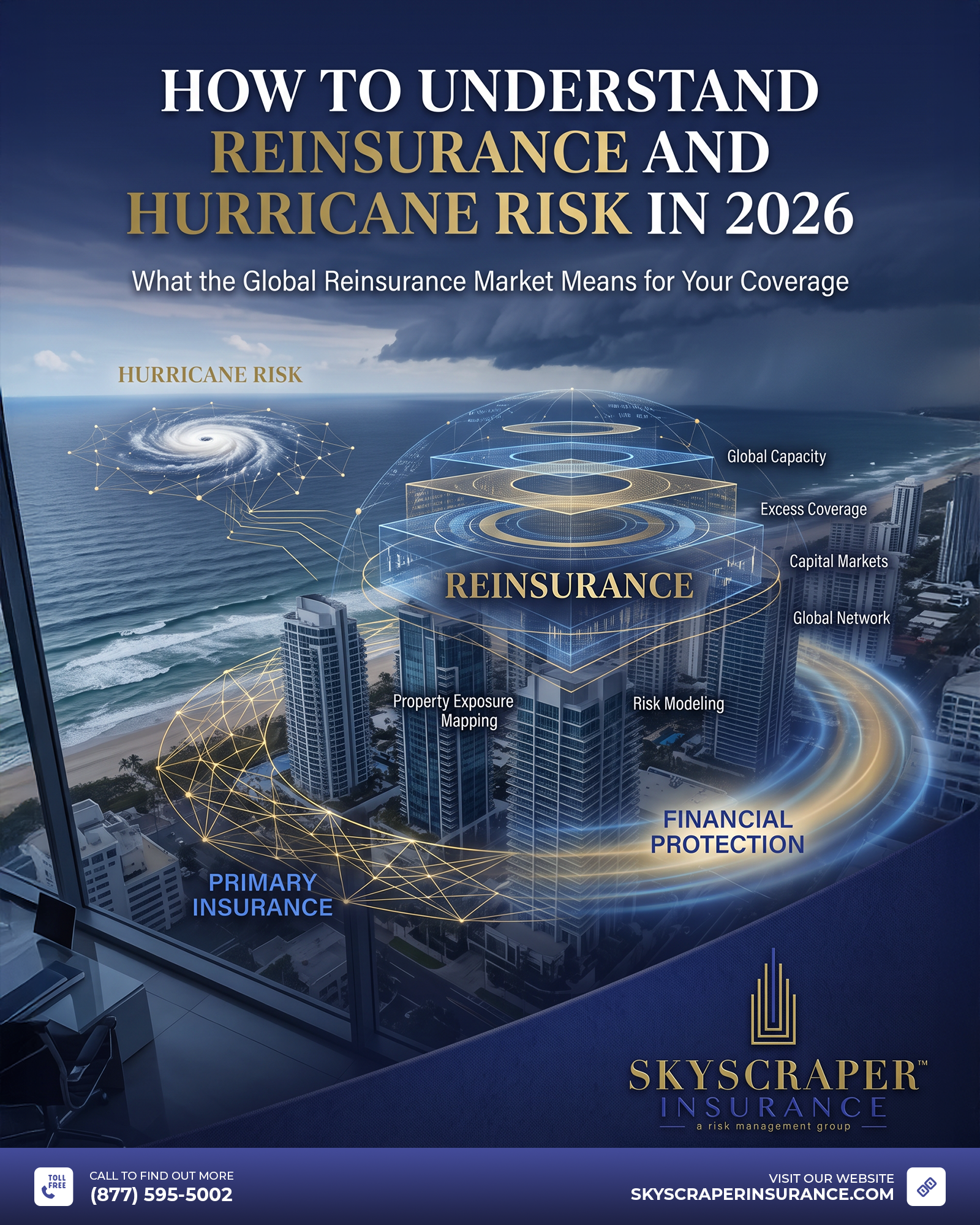
As the Atlantic hurricane season approaches its annual late-summer peak, coastal property owners, commercial real estate operators, and enterprise risk managers are closely monitoring weather models. Natural catastrophes represent one of the most volatile forces in commercial insurance, but the underlying capital protecting the market tells an encouraging story.
Heading into this critical window, the global reinsurance market stands in its strongest financial and capitalization position in years.
Following disciplined underwriting adjustments, rate corrections, and robust investment yields, global reinsurers possess record-high surplus capital to absorb significant storm events without destabilizing primary insurance markets. However, a well-capitalized reinsurance backstop does not automatically guarantee that individual commercial or personal policyholders are fully protected against localized storm damage.
At Skyscraper Insurance, we look past high-level market statistics to evaluate what this environment means for your day-to-day operations. Peak storm season requires understanding the health of the reinsurance market—and ensuring your own coverage is prepared to perform.
1. Capital Strength: Why the Reinsurance Foundation Is Solid
The global reinsurance industry enters the peak 2025 storm season with a solid financial buffer. According to industry outlooks from Fitch Ratings, S&P Global, and leading reinsurance brokers, industry surplus capital exceeds $1.1 trillion, supported by strong operating profitability and expanding alternative capital markets.
The Capital Cushion:
Reinsurance capital supply currently meets or exceeds market demand across most property catastrophe programs. Reinsurers have achieved combined ratios in the low-to-mid 90s, giving carriers the liquidity needed to pay claims rapidly following major landfalls without triggering market freezes or sudden capacity withdrawals.
This capital stabilization has brought order to property catastrophe renewals. Yet while reinsurance carriers are insulated against macro-level shocks, the terms passed down to primary policyholders over recent renewal cycles have permanently altered how commercial property claims are settled.
2. The Primary Policyholder Reality: Deductibles, Sub-limits & Exclusions
While reinsurers are fortified against widespread insolvency, primary commercial and residential policyholders face higher retentions and tighter terms:
Named Storm and Percentage Deductibles
Standard dollar-amount deductibles (e.g., $5,000 or $10,000) have largely been replaced in coastal zones by Percentage Deductibles (ranging from 2% to 5% of Total Insured Value). For a commercial facility valued at $10 million, a 3% named storm deductible means the business must self-fund the first $300,000 of damage out of pocket before coverage responds.
Flood vs. Wind Surge Allocation
One of the most contentious claims issues following hurricane landfalls is the distinction between wind-driven rain and storm surge/rising water. Standard property insurance covers direct wind damage but strictly excludes flood, requiring a dedicated National Flood Insurance Program (NFIP) or private commercial flood policy to prevent severe coverage gaps.
Extended Business Interruption & Extra Expense
A hurricane does not just damage roofs and facades—it knocks out municipal power grids, closes transport corridors, and disrupts supply chains. Ensuring your Business Interruption coverage includes utility services interruption and civil authority extensions ensures ongoing payroll and fixed costs are covered while your facility is inaccessible.
Reinsurance Macro Health vs. Policyholder Risk Realities
Review how reinsurance market dynamics translate into operational considerations for property owners:
| Market Metric | Global Reinsurance Status | Policyholder Operational Reality | Strategic Action |
| Capital Adequacy | Record surplus reserves (over $1.1T) provide high solvency confidence. | High carrier solvency ensures legitimate catastrophic claims are paid. | Confirms your carrier has the liquidity to withstand major storm claims. |
| Catastrophe Attachment Points | Reinsurers maintained higher attachment points, shifting routine loss to primary lines. | Primary carriers enforce higher named-storm percentage deductibles. | Audit liquidity reserves to handle higher self-insured retentions. |
| Property Terms & Conditions | Tightened peril definitions and limited manuscript broad-form extensions. | Stricter exclusions around water intrusion, mold, and secondary structures. | Verify specific sub-limits on roof cosmetic damage and utility services. |
| Capacity & Availability | Orderly renewals with sufficient catastrophe treaty capacity. | High-hazard coastal properties require multi-carrier layered insurance towers. | Structure layered excess property programs to secure required limits. |
Take Control: Review Your Policy
While the global reinsurance sector is ready to absorb the peak of the 2025 hurricane season, your balance sheet’s resilience depends entirely on the specific language, deductibles, and endorsements within your active insurance binder.
At Skyscraper Insurance, we specialize in property risk architecture for commercial portfolios, coastal enterprises, and high-value properties. Our advisors examine your active property binders, analyze named storm deductibles, verify flood allocations, and ensure your business continuity terms are fully aligned with your actual operational exposure.
Is your property fully protected against wind, surge, and operational downtime, or will a named storm reveal costly hidden retentions?
Don’t wait for a tropical system to enter the forecast to verify your coverage limits. Take command of your catastrophe preparedness today, connect with our commercial property specialists, and Review Your Policy. We will execute a forensic review of your active coverage to ensure your assets remain secure through peak hurricane season and beyond.
Visit us at Skyscraper Insurance to schedule your policy review today.