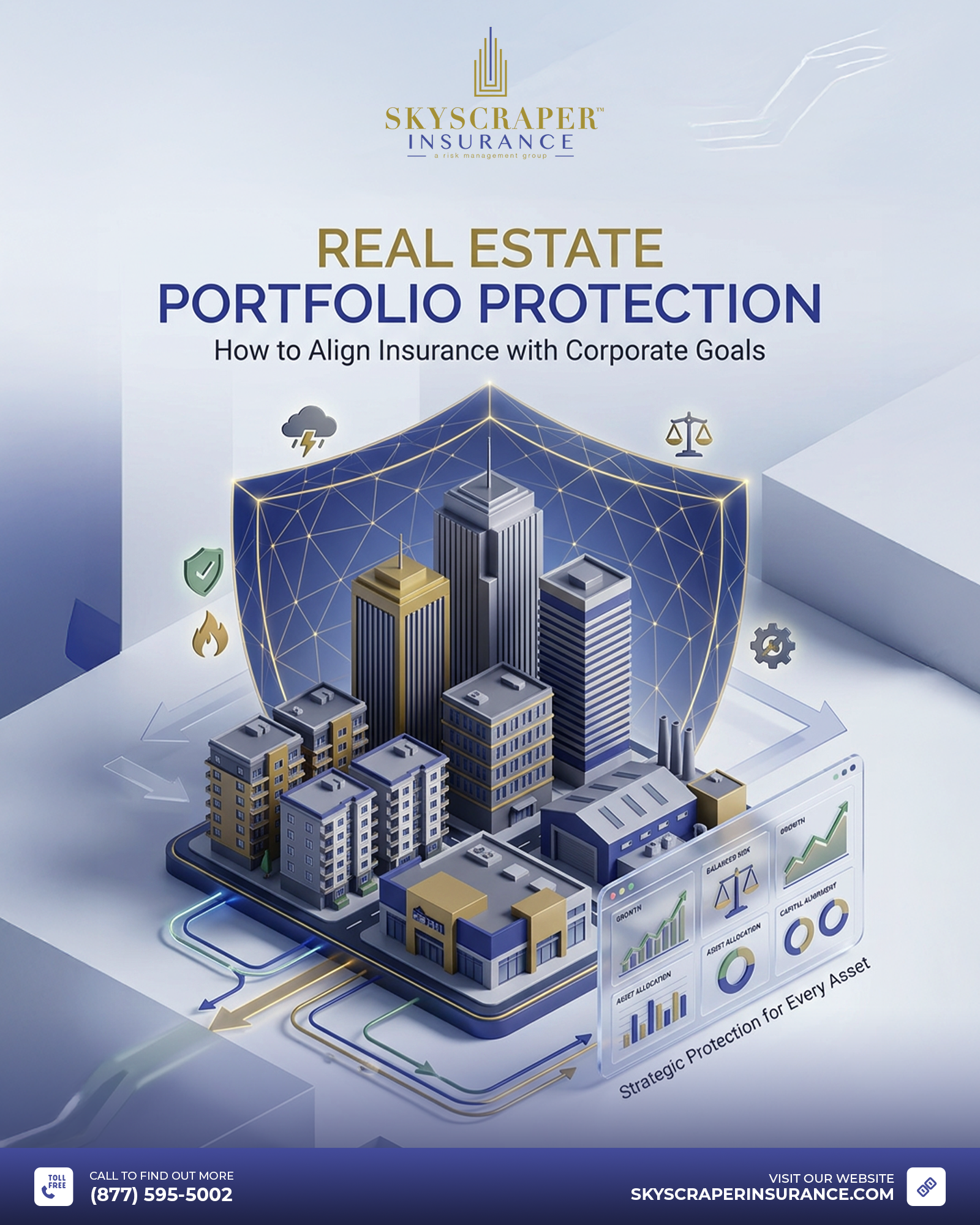
In the commercial real estate world, your physical assets are the literal foundation of your business. Whether you own a single multi-family apartment complex, a portfolio of suburban strip malls, or a sprawling light-industrial warehouse, those brick-and-mortar structures generate the yield that drives your corporate growth.
But real estate is an inherently exposed asset class. Every day, your properties face a barrage of volatile risks: severe weather events, structural failures, tenant negligence, slips and falls, and sudden mechanical breakdowns.
Worse yet, inflation and fluctuating construction material costs mean that a building insured under yesterday’s valuation metrics is a massive liability today. If a disaster strikes and your coverage falls short, it won’t just damage your walls—it can permanently dismantle your corporate balance sheet.
At Skyscraper Insurance, we know that high-performing real estate portfolios require more than basic property coverage. True asset resilience means aligning your insurance architecture with your broader financial goals. When you shield your property correctly, you don’t just mitigate risk—you strengthen your entire business.
1. The Coinsurance Trap: The Hidden Threat to Valuation
The single most dangerous clause hidden within a commercial property policy is the Coinsurance Condition. This clause mandates that you must insure your property for a specific percentage of its true replacement value—typically 80%, 90%, or 100%.
Because replacement costs have risen sharply, many real estate owners are unknowingly carrying severely underinsured assets.
The Math of a Partial Loss Penalty:
Let’s say you own a commercial building with a true, modern replacement cost of $2,000,000. Your policy features an 80% coinsurance clause, meaning you are required to maintain at least $1,600,000 in coverage.
However, based on outdated numbers, you only carry $1,000,000 in limits.
A localized electrical fire breaks out, causing $400,000 in structural damage. You assume your million-dollar limit covers this partial loss entirely. Instead, the adjuster applies the coinsurance formula:
Recovery = Loss X Did Insure/Should Insure
Recovery = $400,000 X $1,000,000\$1,600,000 = $250,000
The carrier cuts a check for $250,000 (minus your deductible), leaving your business to fund the remaining $150,000 out of pocket simply because your valuation baseline was wrong.
2. The Pillars of Elite Commercial Real Estate Protection
To build a property portfolio that can weather any crisis, your insurance program must expand past basic walls-and-roof protection. A comprehensive real estate strategy relies on four critical pillars:
Ordinance or Law Coverage
If an older building suffers a major loss, local building codes will frequently require you to rebuild using modern, more expensive standards (such as updated electrical systems, fire sprinklers, or ADA-compliant ramps). Standard property insurance only pays to restore what was originally there. Ordinance or Law coverage steps in to fund the extra, legally mandated upgrades.
Equipment Breakdown (Boiler & Machinery)
A standard property policy covers external forces like wind or fire, but completely excludes internal mechanical or electrical failure. If an HVAC chiller unit, a primary elevator bank, or a commercial electrical switchboard suffers a sudden, catastrophic mechanical rupture, Equipment Breakdown insurance covers both the massive repair bills and the tenant disruptions that follow.
General Liability & General Aggregate Per Location
When you own multiple properties, a catastrophic slip-and-fall lawsuit at one location can completely drain your policy’s liability limit, leaving your other locations exposed for the rest of the year. Utilizing a Designated Location General Aggregate Endorsement ensures that your liability safety net resets per property, isolating the risk of a single lawsuit from destabilizing your entire portfolio.
The Real Estate Resilience Matrix: Portfolio Exposure vs. Protection
To help your asset management team audit your current program design, see how specific real estate endorsements respond to complex operational threats:
| The Property Peril | The Standard Un-Audited Reality | The Asset Shield Solution | The Strategic Advantage |
| A severe storm rips off the roof, forcing tenants to vacate. | Lost Yield. Property is fixed, but rent collection stops entirely during repairs. | Business Income & Rental Value Coverage: Replaces lost rental revenue for up to 12 or 24 months. | Investor Protection: Keeps your debt service covered and cash flow stable during a rebuild. |
| A main water line bursts behind a wall, causing widespread mold. | Denied. Standard policies explicitly exclude or heavily cap mold remediation. | Fungi, Wet/Dry Rot Limited Limitation Endorsement: Explicitly buys back designated remediation limits. | Liability Mitigation: Protects the business from tenant toxic-exposure lawsuits. |
| A tenant’s manufacturing equipment triggers a major fire. | Litigation Maze. Subrogation battles rage for months while repairs sit in limbo. | Waiver of Subrogation & Strict Tenant Insurance Tracking: Contractually shifts primary liability to tenant policies. | Premium Defense: insulates your primary loss history from being penalized by tenant errors. |
3. Protecting Your Yield: Business Income & Rental Value
For a real estate business, physical damage to a building is only the first phase of a crisis. The true financial killer is the subsequent loss of rental income. If a fire or severe weather event forces your tenants to vacate, your rental cash flow stops instantly—but your bank mortgage payments, property taxes, and payroll obligations do not.
Rental Value Insurance acts as a vital bridge. It replaces your gross tenant revenue while the property is being actively rebuilt, ensuring that your investors remain paid, your credit score stays pristine, and your business survives the operational disruption.
Take Control: Review Your Policy Now
In commercial real estate, an un-audited insurance policy is a structural flaw in your business continuity model. Managing real estate risk isn’t about paying the lowest premium per square foot; it’s about engineering your policies so that your equity, your cash flow, and your properties are completely insulated from market volatility.
At Skyscraper Insurance, we practice forensic real estate risk management. We don’t just issue generic certificates; we analyze your tenant lease structures, verify your modern replacement valuations, stress-test your loss-of-income limits, and negotiate custom endorsements that match your exact asset profile.
Are your properties truly protected at 2026 replacement costs, or are you exposed to a devastating coinsurance penalty?
Don’t wait for a structural loss to find out where your coverage falls short. Take charge of your portfolio’s financial security today and review your policy now. Our specialized real estate risk advisors will run a comprehensive gap analysis, align your valuations with reality, and ensure your business remains built to last.