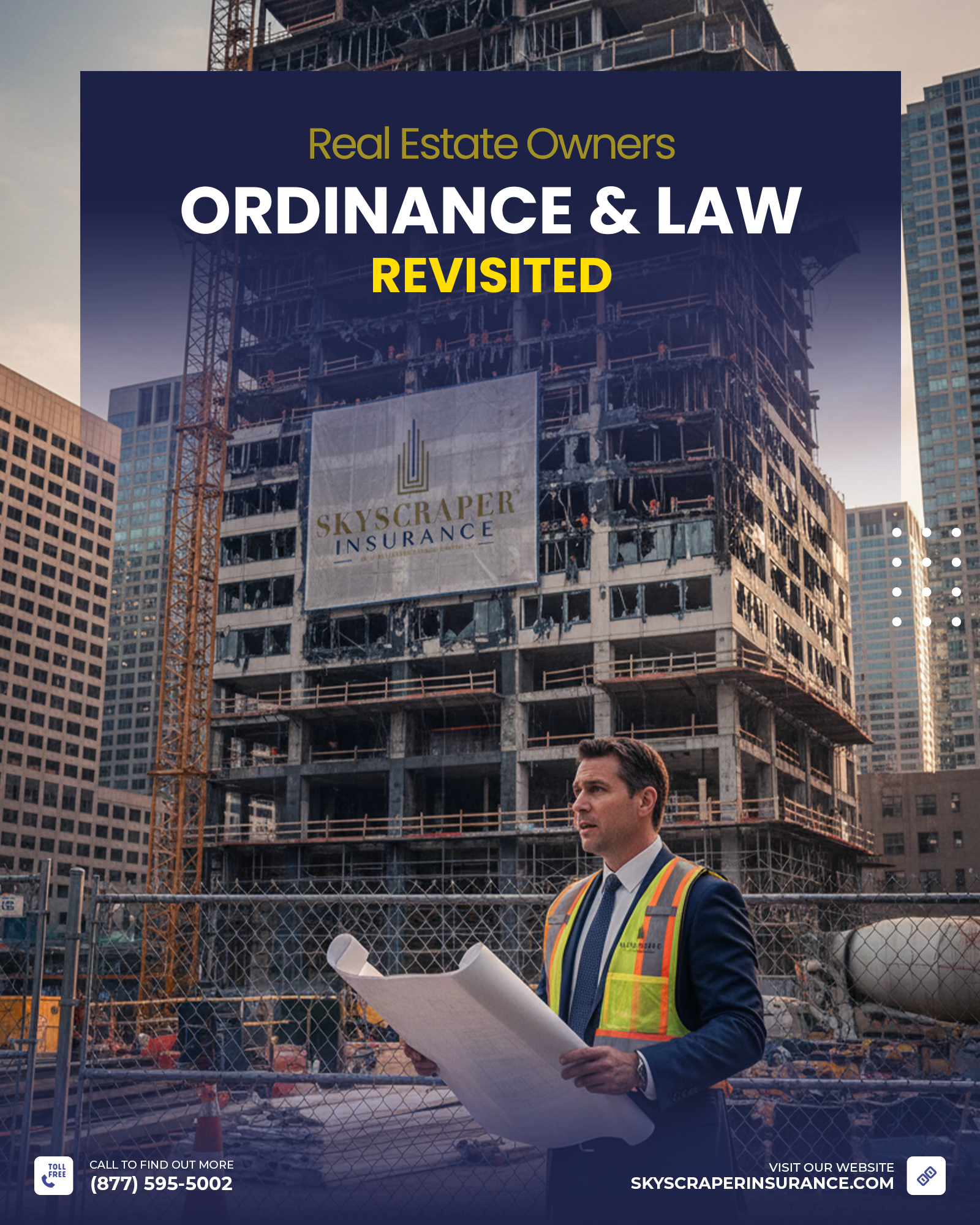
As a commercial real estate owner or investor, protecting your physical assets is the baseline of your financial strategy. You meticulously calculate your cap rates, maintain your facilities, and purchase robust commercial property insurance. But what happens when a catastrophic fire, a severe storm, or a burst pipe exposes a hidden, devastating gap in that very insurance policy?
Many property owners operate under the dangerous assumption that a standard insurance policy will entirely fund the reconstruction of their building after a loss. Unfortunately, the insurance landscape is far more rigid. At Skyscraper Insurance, we routinely see real estate investors blind-sided by the costly rebuild gap—the massive financial shortfall that occurs when modern building codes collide with outdated insurance policies. To protect your portfolio, it is time to revisit Ordinance & Law coverage.
The “Like Kind and Quality” Trap
To understand your exposure, you must first understand how a standard commercial property policy functions. Standard policies are designed to replace damaged property with materials of “like kind and quality.” Their sole legal mandate is to return your building to the exact state it was in the millisecond before the disaster occurred.
However, municipalities, counties, and states constantly update their building codes to enhance safety, accessibility, and energy efficiency. If your property was built in 1990—or even 2015—the codes governing its construction have likely changed dramatically.
If a fire guts your commercial space, the city inspector will not allow you to rebuild it to 1990 standards. They will mandate the installation of modern fire sprinkler systems, ADA-compliant entryways and restrooms, upgraded electrical wiring, and hurricane-rated roofing. Because your standard property policy only pays to replace what was originally there, it explicitly excludes the cost of these legally mandated upgrades. Without Ordinance & Law coverage, you will be forced to pay for these expensive modernization requirements entirely out of your own pocket.
Dissecting the Coverage: The Three Pillars
Ordinance & Law coverage is specifically designed to fill this massive financial void. It is not a single, blanket protection, but rather a three-part endorsement. To fully grasp how this coverage operates during a catastrophic loss, review the breakdown below:
| Coverage Component | The Costly Rebuild Gap It Fills | Real-World Scenario |
| Coverage A: Loss to the Undamaged Portion | Covers the value of the undamaged part of a building if local laws require the entire structure to be demolished after a partial loss. | A fire destroys 60% of your retail plaza. The city dictates that any building over 50% damaged must be entirely leveled. Coverage A pays for the 40% that wasn’t burned. |
| Coverage B: Demolition Costs | Pays for the actual labor, heavy equipment, and haul-away costs required to tear down the undamaged portion of the building. | After the city mandates total destruction of the retail plaza, Coverage B pays the demolition contractors to legally tear down and remove the unburned 40% of the structure. |
| Coverage C: Increased Cost of Construction | Funds the mandatory upgrades required to bring the newly rebuilt structure into full compliance with current local building codes and zoning laws. | During the rebuild, the city requires you to widen all hallways for ADA compliance and install an energy-efficient HVAC system. Coverage C pays for these expensive upgrades. |
The “Grandfathered” Myth
One of the most common and dangerous misconceptions among real estate owners is the reliance on “grandfathered” status. Property owners often assume that because their aging building is legally permitted to operate today, it will be exempt from modern codes during a rebuild.
This is a fatal financial error. Grandfather clauses generally only protect you during normal, uninterrupted business operations. The moment your property suffers significant damage and you apply for a reconstruction permit, your grandfathered status is immediately revoked. You are legally forced to comply with the building codes of today, not the codes of the year your property was built. Furthermore, even owners of relatively new buildings are at risk; building codes evolve rapidly, and a property built just five years ago may already be out of compliance with newly passed energy or structural regulations.
Close the Gaps Before Disaster Strikes
A real estate investment should generate wealth, not act as a ticking financial time bomb. Relying on basic commercial property insurance while ignoring the severe implications of evolving municipal building codes is a risk you cannot afford to take. If your policy lacks adequate Ordinance & Law sublimits, a single severe storm or structural fire could wipe out your operating capital and drastically diminish your property’s long-term market value.
At Skyscraper Insurance, our specialized commercial brokers know exactly where these costly rebuild gaps hide within the fine print. We advocate for proactive risk management, ensuring that your portfolio is fortified against both physical disasters and regulatory financial traps.
Protect your investments today. Reach out to our team to schedule a comprehensive Coverage review. Our experts will dissect your current property policies, expose any dangerous sublimits, and ensure your real estate assets are fully protected against the rising costs of modern code compliance.