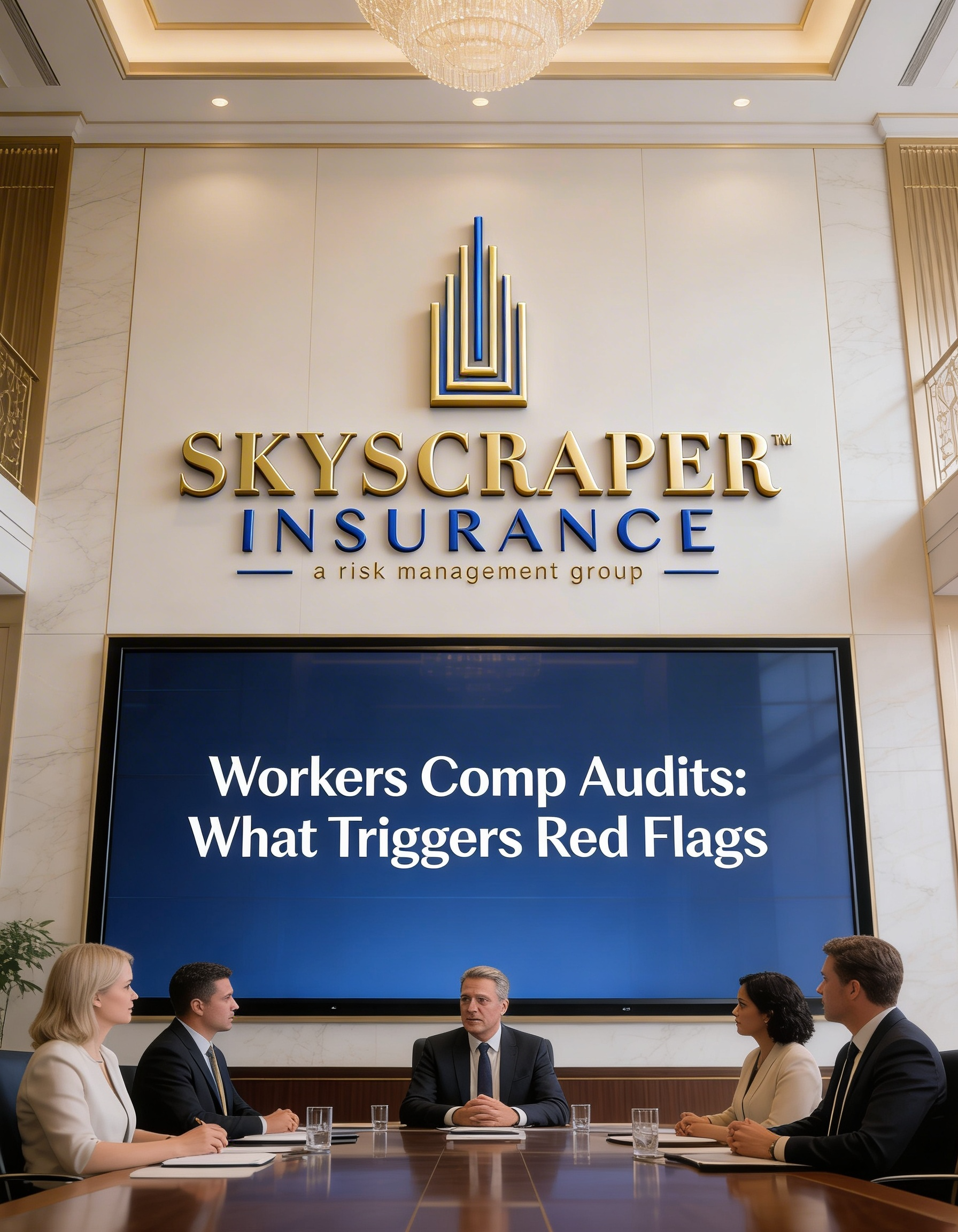
In the world of business management, few words inspire as much “split-second” dread as the word “Audit.” It often feels like the insurance company is sending an investigator to look for mistakes. But at Skyscraper Insurance, we take a higher perspective. A Workers’ Compensation premium audit isn’t an interrogation; it’s a recalibration.
Because Workers’ Comp premiums are based on estimates, specifically your projected payroll, the audit is simply the process of matching those estimates to reality. However, certain discrepancies can act as “red flags,” signaling to underwriters that your risk profile might be higher than originally thought. Understanding these triggers is the key to maintaining a solid financial foundation and protecting the legacy you’ve built.
The Mechanics of the “Red Flag”
When an auditor reviews your books, they aren’t just looking at the total dollar amount. They are looking for consistency. If your business is a living, breathing entity, its data should tell a coherent story. When the story doesn’t match the industry standard, red flags are raised.
1. The Classification Gap: Mislabeling Your Team
The most common, and expensive red flag is misclassification. Every job role has a specific “class code” with a corresponding rate based on risk.
- The Trap: Thinking you can “save” money by classifying field workers as clerical staff.
- The Reality: Auditors are experts at spotting “clerical” payroll that seems too high for a construction or retail firm. If a “clerical worker” is injured on a job site, not only will the claim be scrutinized, but your entire audit will be flagged for a deeper dive.
| Employee Role | Common Risk | Correct Perspective |
| Field/Site Staff | High-frequency physical risk. | Needs high-rate classification to ensure full protection. |
| Sales/Travel | Vehicle & movement risk. | Often lower than field, but higher than clerical. |
| Office/Clerical | Low physical risk. | Only for staff with zero exposure to site or lot hazards. |
2. The Subcontractor Trap: Missing Certificates (COIs)
For those in pre-construction or development, subcontractors are a necessity. However, if you hire a sub who doesn’t carry their own Workers’ Comp insurance, you become their insurer by default.
During an audit, if you cannot provide a valid Certificate of Insurance (COI) for every subcontractor you paid, the auditor will add their entire contract labor cost to your payroll. This can lead to a massive, unexpected premium bill that stalls your success just as you’re trying to scale.
3. Payroll Volatility: The “Unexplained Spike”
Auditors look for ratios. If your payroll suddenly doubles, but your revenue stays flat, it signals a potential paperwork error or a change in operations that hasn’t been reported. Conversely, if your payroll drops significantly while you’re taking on larger projects, underwriters may worry that you are under-reporting to lower your “standard” plan costs.
4. The E-Mod Signal: Claims Frequency
As we’ve discussed before, your Experience Rating Modifier (E-Mod) is your business’s financial DNA. If your E-Mod is rising due to a high frequency of “small” claims, it tells the auditor that your safety culture might be fraying. Frequency is a leading indicator of a future catastrophic loss. When an auditor sees a high E-Mod paired with messy record-keeping, it’s a signal that the business is at a higher risk of failing its “vital safety net.”
The Hidden Costs of a Failed Audit
A red-flagged audit doesn’t just result in a one-time bill. It can lead to:
- Loss of Credits: Many insurers offer “safety credits” or “preferred pricing” that can be revoked if an audit reveals poor management.
- Non-Renewal: If the auditor finds intentional misrepresentation, the carrier may choose to “non-renew,” forcing you into the high-cost “assigned risk” market.
- Increased Scrutiny: Once you are flagged, your business will likely be subject to more frequent and rigorous physical audits in the future.
Preparation: The Foundation of Audit Readiness
At Skyscraper Insurance, we believe that a protected site is a site where you can build with confidence. You shouldn’t be “reacting” to an audit; you should be prepared for it year-round.
- Maintain a COI Log: Use a digital system to track subcontractor insurance expiration dates before they hit the job site.
- Reconcile Quarterly: Don’t wait until the end of the year. Match your payroll reports to your class codes every 90 days.
- Separate Your Records: Keep overtime pay, bonuses, and severance in separate columns. Most states allow you to exclude the “overtime premium” (the extra half-time pay) from your audit totals, which can save you thousands.
Take Action: Secure Your Audit Foundation
Don’t let a paperwork error or a missing certificate halt your vision. A “standard” insurance plan is not enough to protect you from the complexities of a modern audit. You need a partner who takes a higher perspective on your risk management.
Is your business truly prepared for its next audit? Don’t wait for the red flags to fly.
Schedule an Audit Readiness Review today. Our team will conduct a “pre-audit” of your records, identifying the gaps and misclassifications before they become financial liabilities. We share your vision for a better tomorrow, and that starts with a clean bill of health today.
Skyscraper Insurance: The higher perspective on your business’s future.