As a growing enterprise, managing human resources, payroll, workers’ compensation, and employee benefits can quickly become an overwhelming burden. Enter the Professional Employer Organization (PEO). PEO programs pitch a highly compelling “all-in-one” solution, promising to handle the heavy administrative lifting so business owners can focus purely on scaling their operations. But before you sign on the dotted line, you must profoundly understand the co-employment model’s true cost. What are you actually giving up in exchange for this convenience?
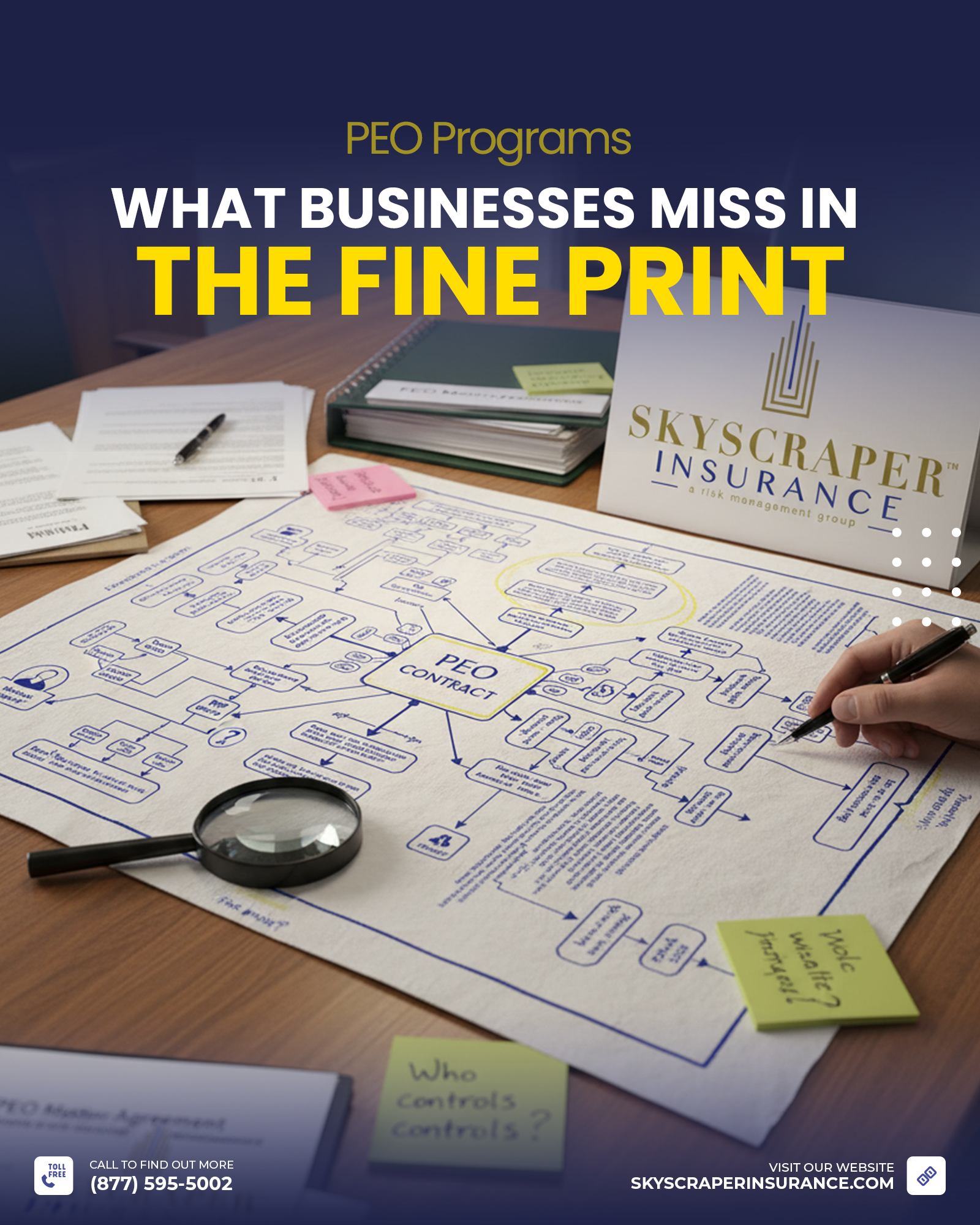
At Skyscraper Insurance, we routinely audit these complex contracts for our clients. Time and time again, we discover that the most critical details—specifically the intricate cost versus control trade-offs, are buried deep within the PEO fine print.
The Cost Illusion: Bundled Pricing vs. Financial Transparency
One of the primary selling points of a PEO is access to premium employee benefits and workers’ compensation rates, theoretically achieved through the PEO’s massive economies of scale. However, the financial reality hidden in the fine print is often a frustrating lack of transparency.
PEOs typically utilize bundled pricing structures. This means your administrative fees, payroll processing costs, workers’ compensation premiums, and health insurance costs are rolled into one opaque invoice, or worse, billed as a percentage of your total payroll. When your costs are tied to a percentage of payroll, your PEO fees artificially inflate every time you give a hardworking employee a raise, authorize overtime, or hire higher-salaried executive staff—even if the actual HR workload hasn’t changed one bit. Without line-item transparency, it becomes nearly impossible for a business to isolate exactly what they are paying for insurance premiums versus PEO administrative overhead.
The Control Sacrifice: Your Business, Their Rules
The fundamental legal and operational structure of a PEO relies on “co-employment.” While you retain day-to-day management of your staff, the PEO becomes the “employer of record” for tax and insurance purposes. This is the exact intersection where businesses lose significant operational control.
- Rigid Carrier Selection: You no longer get to independently shop the insurance market for the most competitive health insurance or workers’ compensation carriers. You are locked into the PEO’s master policies. If the PEO experiences high claims across its entire national network, your rates can skyrocket, and you cannot easily switch insurance carriers without leaving the PEO entirely.
- Dictated HR Policies: Because the PEO shares legal liability, they dictate your HR policies. You must strictly adhere to their standardized employee handbook, their disciplinary procedures, and their exact termination protocols. A simple operational decision can suddenly require layers of bureaucratic approval.
- The SUTA Tax Trap: Leaving a PEO is notoriously difficult. Because employees are filed under the PEO’s Employer Identification Number (EIN), leaving means you must “re-hire” your workforce under your own EIN. This often causes your State Unemployment Tax Act (SUTA) rates to reset mid-year, creating an unexpected and massive tax burden.
Cost vs. Control: Breaking Down the Trade-Offs
To better understand what is truly at stake, let’s break down the critical differences between the PEO model and an independent brokerage model in a side-by-side comparison.
| Feature | PEO Model (The Fine Print) | Traditional Brokerage Model |
| Pricing Structure | Bundled, opaque fees; often a percentage of total payroll. | Transparent, line-item pricing; flat tech fees. |
| Insurance Carriers | Locked into the PEO’s specific master insurance policies. | Complete freedom to shop multiple carriers. |
| HR Control | Must adhere to the PEO’s rigid corporate HR guidelines. | Total control over your customized HR policies. |
| Risk Pooling | You share the claims risk of the PEO’s entire national network. | Your rates are based entirely on your own claims data. |
| Exit Strategy | High friction; requires “re-hiring” staff and SUTA tax resets. | Low friction; easily change brokers or software tools. |
Stop Guessing. Start Comparing.
Navigating the extreme complexities of HR outsourcing doesn’t mean you have to sacrifice control or blindly accept opaque pricing structures. At Skyscraper Insurance, our expert insurance brokers help you unbundle the confusion. We rigorously evaluate your current setup, expose hidden administrative fees, and design customized employee benefits and risk management strategies tailored exclusively to your unique business needs.
Don’t let the fine print dictate your company’s financial future. It’s time for a transparent, data-driven PEO comparison. Let us run the numbers to see if a traditional brokerage model, combined with modern HR technology, serves your bottom line far better than a restrictive co-employment contract.
Protect your business and take back control. Reach out to our team to schedule your comprehensive PEO audit and side-by-side comparison today!
Skyscraper Insurance: We Share Your Vision For a Better Tomorrow!