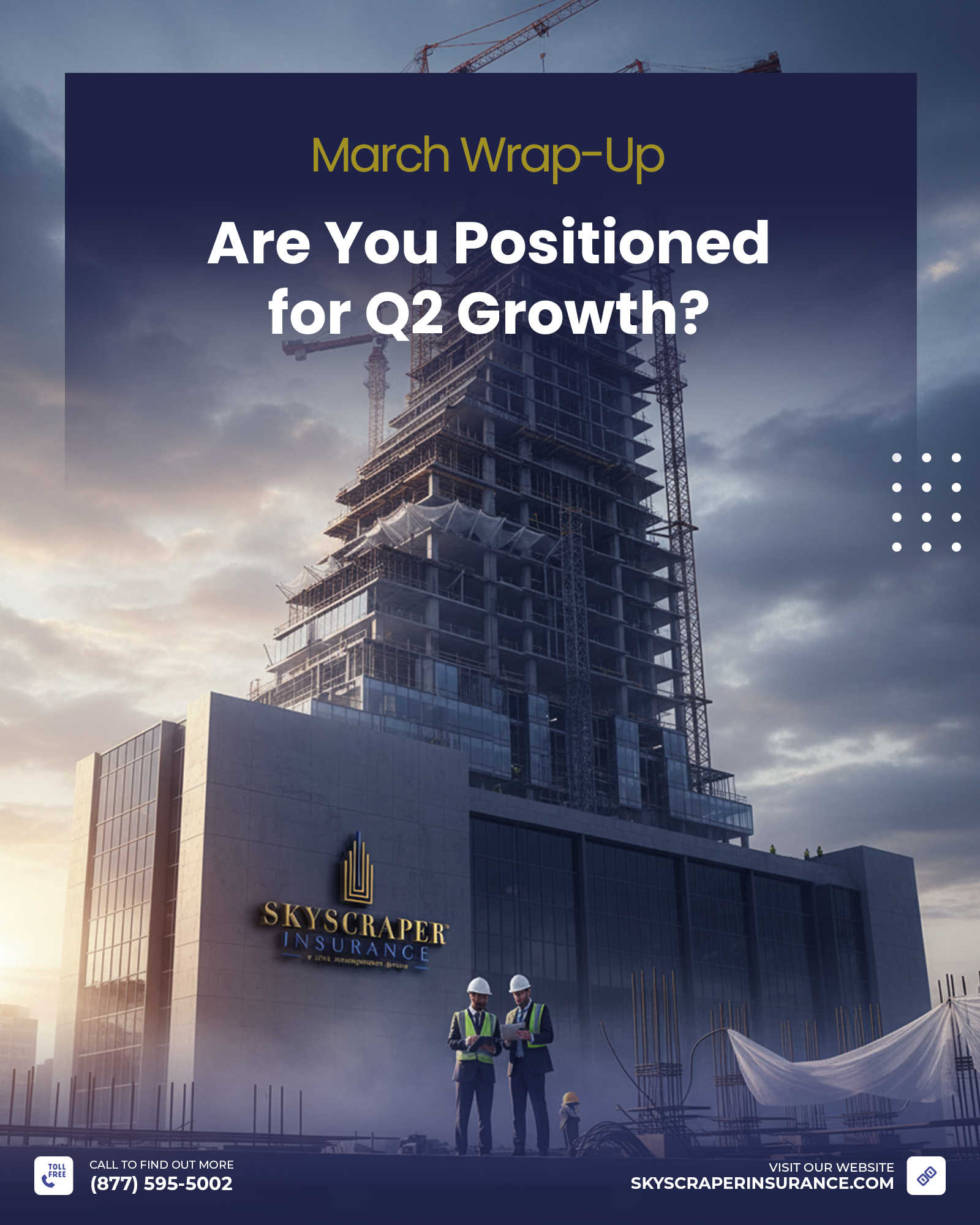
The first quarter of the year is officially in the books. For many business owners, Q1 is a season of recovery, tax preparation, and foundational setting. But as the calendar turns to April, the energy shifts. Spring isn’t just about the weather; in the corporate world, Q2 represents the “Go” phase. This is the quarter where marketing campaigns launch, hiring freezes melt away, and capital expenditures finally hit the books.
However, growth is a double-edged sword. As you scale your operations, your risk profile transforms in real-time. Too often, ambitious companies outpace their insurance coverage before the mid-year mark, leaving them exposed to “success surcharges”—unexpected liabilities that arise simply because the business is doing well. At Skyscraper Insurance, we believe that your insurance should be a tailwind for your growth, not a reactive anchor.
Are you truly positioned for the expansion ahead, or are you scaling on a shaky foundation? Let’s look at the critical areas of coverage readiness you need to address before Q2 hits full stride.
The Scaling Trap: Why Q1 Policies Often Fail in Q2
Most commercial insurance policies are built on projections. When you renewed your coverage at the start of the year, you likely provided estimates for your annual revenue, total payroll, and fleet size. If Q2 goes according to your growth plan, those January estimates may already be obsolete by mid-April.
If your revenue is climbing 20% faster than anticipated, your General Liability limits may no longer be sufficient for the larger contracts you are bidding on. Similarly, if you are ramping up production to meet spring demand, your Workers’ Compensation projections need to be adjusted. Waiting until the end-of-year audit to fix these numbers often results in massive, unbudgeted additional premium bills that can cripple your Q4 cash flow. Proactive adjustment in Q2 is the only way to maintain a predictable balance sheet.
Inventory and Equipment: The Hidden Values
Spring often brings a surge in inventory and new equipment purchases. Whether you are a contractor investing in a new fleet of vehicles or a retailer stocking up for a peak season, your Commercial Property and Inland Marine policies must reflect the “Total Insured Value” (TIV) of what is actually on your floor or in your trucks today.
Inflation hasn’t just affected consumer goods; it has drastically increased the replacement cost of specialized machinery and building materials. If you haven’t revisited your property limits since last year, you may be co-insuring your own loss. This means that in the event of a fire or theft, the insurance company could penalize your payout because the building or equipment was significantly undervalued on the policy.
The Human Element: Hiring and Liability
Q2 is traditionally a heavy hiring season. As you add new team members to support your growth, your exposure to Employment Practices Liability Insurance (EPLI) and Workers’ Comp increases exponentially.
- EPLI: New hiring rounds mean more interviews, more background checks, and more opportunities for claims related to “failure to hire” or discrimination.
- Onboarding: Rapid onboarding can sometimes lead to lapses in safety training. A single workplace injury during a growth spurt doesn’t just cost money in claims—it halts your momentum.
Growth Readiness: Q1 Maintenance vs. Q2 Scaling Focus
To help you visualize where your focus should shift this month, review the comparison table below. Moving from a “maintenance” mindset to a “growth” mindset is essential for protecting your Q2 upside.
| Growth Milestone | Q1 Maintenance Status (Reactive) | Q2 Scaling Focus (Proactive) |
| Revenue Growth | Using year-end 2025 data for limits. | Adjusting General Liability to match Q2 contract bids. |
| Workforce Expansion | Managing existing staff claims. | Auditing payroll projections and safety training for new hires. |
| New Equipment | Insuring old assets at book value. | Adding new purchases to Inland Marine at replacement cost. |
| Digital Expansion | Basic firewall and standard Cyber policy. | Mapping new data flows and increasing Cyber sub-limits. |
| Fleet & Logistics | Renewing existing driver MVRs. | Reviewing Hired & Non-Owned Auto for seasonal delivery spikes. |
The “Success Surcharge”: Don’t Get Audited by Surprise
One of the most frustrating experiences for a growing business is the “Premium Audit.” This usually happens after the policy year ends, when the carrier looks at your actual revenue and payroll versus what you predicted. If you grew significantly, they send you a bill for the difference.
By conducting a mid-year or “March Wrap-Up” review, we can help you adjust these numbers in real-time. This allows you to pay the correct premium as you earn the revenue, rather than being hit with a $20,000 or $50,000 surprise bill a year from now when you’re trying to plan for 2027.
Planning for the Quarter Ahead
Success in business requires a rare combination of optimism and paranoia. You have to believe in your growth, but you have to protect the assets that make that growth possible. As you finalize your Q2 goals, make sure “Insurance Readiness” is at the top of the executive summary.
At Skyscraper Insurance, we don’t just sell policies; we build growth-ready risk frameworks. We look at your pipeline, your hiring plans, and your capital expenditure goals to ensure that your insurance is an asset, not a liability.
Are you ready to execute your Q2 strategy with total confidence? Don’t leave your expansion to chance. It’s time to align your coverage with your ambitions. Contact our team today to schedule your Q2 planning call. We will review your current limits, adjust your projections, and ensure that your business is fully positioned to win the quarter.
Skyscraper Insurance: We Share Your Vision for a Better Tomorrow!