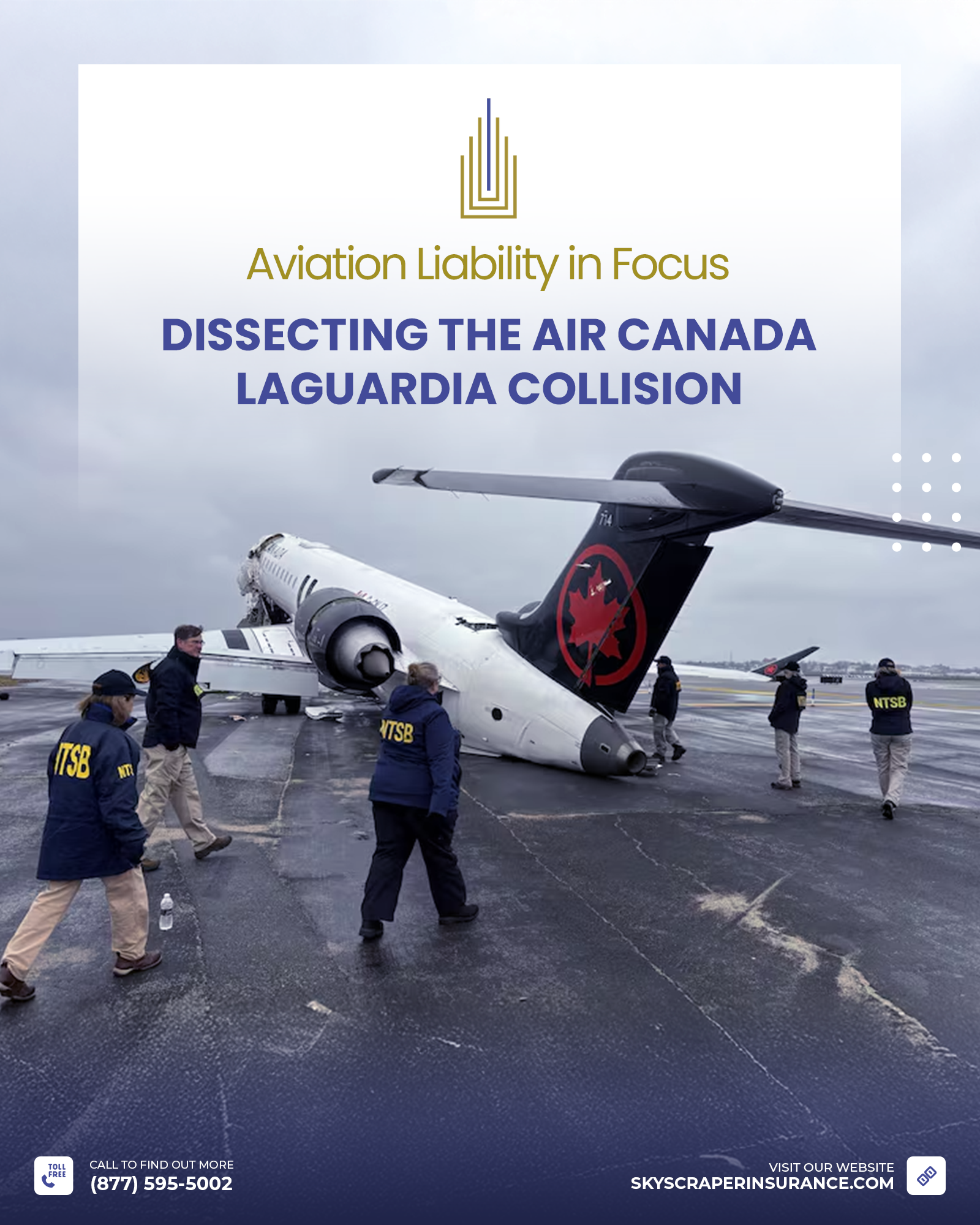
The recent tragic collision at New York’s LaGuardia Airport is a sobering reminder of the compounding risks inherent in modern aviation. Late Sunday night, a Bombardier CRJ-900 regional jet operating as Air Canada Express struck a Port Authority Aircraft Rescue and Firefighting (ARFF) vehicle on the runway. The incident tragically claimed the lives of two pilots, injured dozens of passengers and first responders, and forced a complete ground stop at one of the nation’s busiest transit hubs.
While the immediate focus remains squarely on recovery and the National Transportation Safety Board (NTSB) investigation, the aftermath of this disaster is already triggering a massive, multi-jurisdictional insurance response. At Skyscraper Insurance, we closely monitor these complex liability scenarios because they expose the intricate frameworks governing commercial transportation, ground handling, and municipal exposure. When a cross-border flight collides with a state agency vehicle on a US runway, who is ultimately held responsible, and how do insurance limits apply?
The Montreal Convention: Governing Cross-Border Claims
Because the Air Canada Express flight originated in Montreal before landing in New York, the legal mechanism governing passenger injury and death claims immediately defaults to the Montreal Convention. This international treaty serves as the absolute cornerstone of cross-border aviation liability.
Under the recently revised limits that took effect in December 2024, the Montreal Convention imposes a strict liability threshold of 151,880 Special Drawing Rights (SDRs)—which translates to roughly $202,500 USD per passenger. Up to this limit, the air carrier is strictly liable for proven damages, regardless of fault. However, if injured parties or the families of the deceased seek damages exceeding that $202,500 threshold, they face a significantly higher legal burden: they must definitively prove carrier negligence. If the airline can prove they took all necessary measures to avoid the damage, or that the damage was solely caused by a third party, their financial exposure above the strict liability limit could be capped.
Municipal Exposure: The Port Authority’s Liability
The complexity of this collision drastically increases because the second vehicle involved was operated by the Port Authority of New York and New Jersey. Historically, government agencies often rely on sovereign immunity to shield themselves from massive liability claims. However, the legal landscape in New York has recently shifted.
Following a pivotal Second Circuit ruling in December 2025, the Port Authority does not enjoy absolute sovereign immunity from state-law claims in federal court. Under current New York law, the agency essentially consents to tort liability on the exact same terms as a private corporation. This means that if the ARFF vehicle is found partially or entirely at fault for being on an active runway, the Port Authority—and its liability insurers—could face direct legal action from the airline, the passengers, and the crew’s estates. It is critical to note, however, that plaintiffs pursuing the Port Authority face an extremely tight one-year filing window.
Liability Frameworks at a Glance: The LaGuardia Incident
To understand the competing insurance interests at play, let’s break down the primary liability frameworks governing this tragic runway collision:
| Entity Involved | Primary Liability Framework | Legal Standard & Limits |
| Air Canada / Jazz Aviation | The Montreal Convention (International Treaty) | Strict liability up to ~ $202,500 USD (151,880 SDRs) per passenger. Claims above this require definitive proof of carrier negligence. |
| Port Authority of NY & NJ | New York State Tort Law | Treated legally as a private corporation; no full sovereign immunity. Subject to a strict one-year statute of limitations for filing claims. |
| Ground Handling / ATC | Domestic Negligence / Tort Law | Standard negligence burden of proof if air traffic control or runway managers are implicated in the crash sequence. |
Broader Implications for the Aviation Insurance Market
This catastrophe arrives at an already strained moment for the global aviation insurance market. According to recent data from Allianz Commercial, collisions and crash incidents accounted for a staggering 63 percent of all aviation insurance claims by value over the preceding five years, with ground handling incidents at major airports representing a rapidly growing concern. As industry outlooks for 2026 suggest continued technical rate increases, particularly for operators with US exposures, this high-profile LaGuardia incident will undoubtedly put further upward pressure on aviation and commercial liability premiums.
Protect Your Operations in a Complex Legal Landscape
Whether you operate a commercial fleet, manage ground handling logistics, or supply critical airport infrastructure, the legal frameworks governing your risk are constantly shifting. Relying on outdated policies or misunderstanding your exposure to international treaties can leave your balance sheet dangerously exposed.
Do not wait for a catastrophic incident to test the limits of your commercial insurance coverage. Our expert brokers are ready to dissect your operational risks, analyze your indemnification agreements, and ensure your policies perfectly align with the latest jurisdictional rulings. Take proactive control of your corporate risk today. Reach out to our team to schedule a comprehensive Commercial Liability Review and fortify your enterprise against the unexpected.
Skyscraper Insurance: We Share Your Vision for a Better Tomorrow!