In the modern corporate landscape, the horizon is shifting faster than ever before. For decades, traditional risk management relied almost entirely on historical data. Actuaries and risk managers looked backward, analyzing decades of fire, slip-and-fall, and vehicular accident data, to project future liabilities and price insurance policies accordingly.
But we no longer live or operate in a slow-moving, historical world.
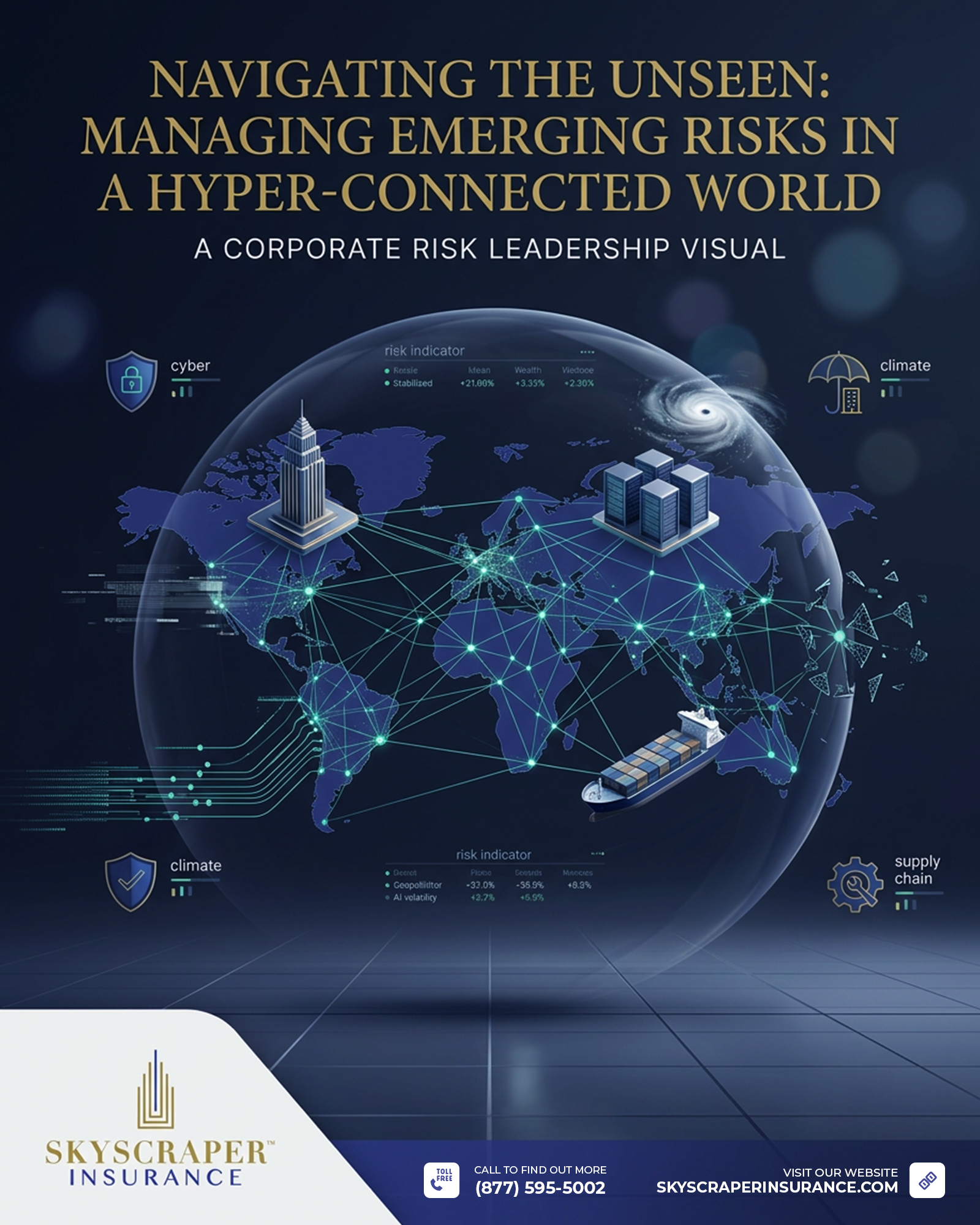
We are navigating an era defined by rapid technological leaps, shifting global climates, decentralized workforces, and highly volatile geopolitical landscapes. Today, businesses across all sectors face a wave of emerging risks, new, evolving exposures that have little to no historical precedent.
At Skyscraper Insurance, we know that yesterday’s insurance paradigms cannot protect tomorrow’s innovations. Waiting for an emerging risk to trigger a major corporate loss before adjusting your coverage isn’t a strategy; it’s a failure of foresight. True corporate resilience requires anticipating the unknown and actively engineering your policy architecture to shield your business from the threats of tomorrow.
1. The Artificial Intelligence & Deepfake Exposure
Artificial Intelligence (AI) has moved rapidly from a tech-sector buzzword to a core operational engine across retail, finance, healthcare, and manufacturing. While AI drives incredible efficiencies, it also introduces a massive, unregulated frontier of corporate liability.
Standard Cyber Liability and Professional Liability (Errors & Omissions) policies were written long before the advent of generative AI, creating dangerous coverage blind spots.
The Reality of AI Litigation:
If your marketing team uses a generative AI tool that accidentally scrapes copyrighted imagery, or if your software engineers deploy AI-generated code that contains an unknown proprietary patent violation, your business faces massive intellectual property lawsuits.
Furthermore, bad actors are now utilizing highly sophisticated AI deepfakes to execute social engineering fraud—mimicking a CFO’s voice or video likeness to authorize multi-million-dollar wire transfers. Standard crime or cyber policies frequently deny these claims, citing that the transfer was “voluntarily authorized” by staff.
2. The Decentralized Grid & Renewable Energy Vulnerability
As the corporate world transitions toward sustainability, businesses are investing heavily in green infrastructure—installing commercial solar arrays, building out electric vehicle (EV) fleet charging hubs, and integrating with localized smart grids.
While this strengthens environmental profiles, it completely alters your property and equipment breakdown exposure.
Traditional property insurance is designed for standard electrical rooms and brick-and-mortar structures. It is largely unequipped to handle the high-load volatility of commercial lithium-ion battery energy storage systems (BESS). A single thermal runaway event in a battery storage unit can trigger an chemical fire that is virtually impossible to extinguish with standard sprinkler systems, resulting in total property destruction and severe environmental pollution liability.
The Emerging Risk Matrix: Modern Threats vs. Strategic Defenses
To help your executive leadership team audit your organization’s current exposure to evolving hazards, review our alignment matrix below:
| Evolving Corporate Threat | The Un-Audited Risk Reality | The Optimized Skyscraper Solution | The Strategic Advantage |
| Biometric Data Privacy Violations | Tracking employee fingerprints or facial scans for clock-ins triggers massive statutory fines (e.g., BIPA violations). | Employment Practices Liability (EPLI) & Cyber Upgrades: Explicitly structures defense limits for biometric privacy claims. | Regulatory Defense: Shields corporate cash reserves from aggressive class-action privacy lawsuits. |
| Silent Cyber Exposure | Modern automated manufacturing machinery is crippled by malware, but standard property policies deny the claim because there is no “physical” damage. | Forensic Cyber-Property Integration: Custom endorsements that bridge the gap between physical property loss and digital disruption. | Operational Continuity: Guarantees asset protection when digital data disruptions cause physical operational freezes. |
| Geopolitical Supply Chain Chokepoints | A sudden regional conflict or digital infrastructure blackout halts international shipping routes. | Political Risk & Contingent Business Interruption (CBI) Overhaul: Expands supply chain definitions globally to capture macroeconomic chaos. | Yield Stabilization: Replaces lost gross revenue when global trade nodes are paralyzed. |
3. The Biometric and Digital Identity Frontier
As businesses look to tighten security, many have adopted biometric authentication—collecting employee or customer fingerprints, facial recognition scans, or iris data to control access to facilities and digital networks.
However, regulatory frameworks are penalizing companies that mishandle this hyper-sensitive information. Statutory laws enforce severe, per-violation fines for companies that collect biometric data without explicit, legally pristine disclosure and consent forms. If your data vendor suffers a breach and your employees’ biometrics are compromised, you cannot simply issue them a new password. The liability is permanent, and the class-action lawsuits can easily cripple an enterprise.
Take Control: Future-Proof Your Organization
You cannot manage 2026’s risks using a policy binder structured in 2020. In a hyper-connected, rapidly evolving global market, staying safe requires active, forensic risk engineering. Emerging risks shouldn’t freeze your corporate growth; they should simply change how you design your defenses.
At Skyscraper Insurance, we practice forensic corporate risk forecasting. We don’t just issue generic renewals. Our dedicated specialized risk advisors sit down with your tech, operations, and compliance teams to stress-test your modern exposures, close hidden policy gaps, and negotiate bespoke endorsements with top-tier global underwriters who specialize in frontier risks.
Are your corporate assets built to withstand the next wave of technological and environmental disruption, or are you flying blind into an uninsurable crisis?
Don’t wait for a novel claim denial to discover where your coverage falls short. Take command of your organization’s future today, reach out to our team, and schedule an emerging risk audit. Let us stress-test your modern operational footprint, protect your corporate legacy, and ensure your enterprise remains built to last.