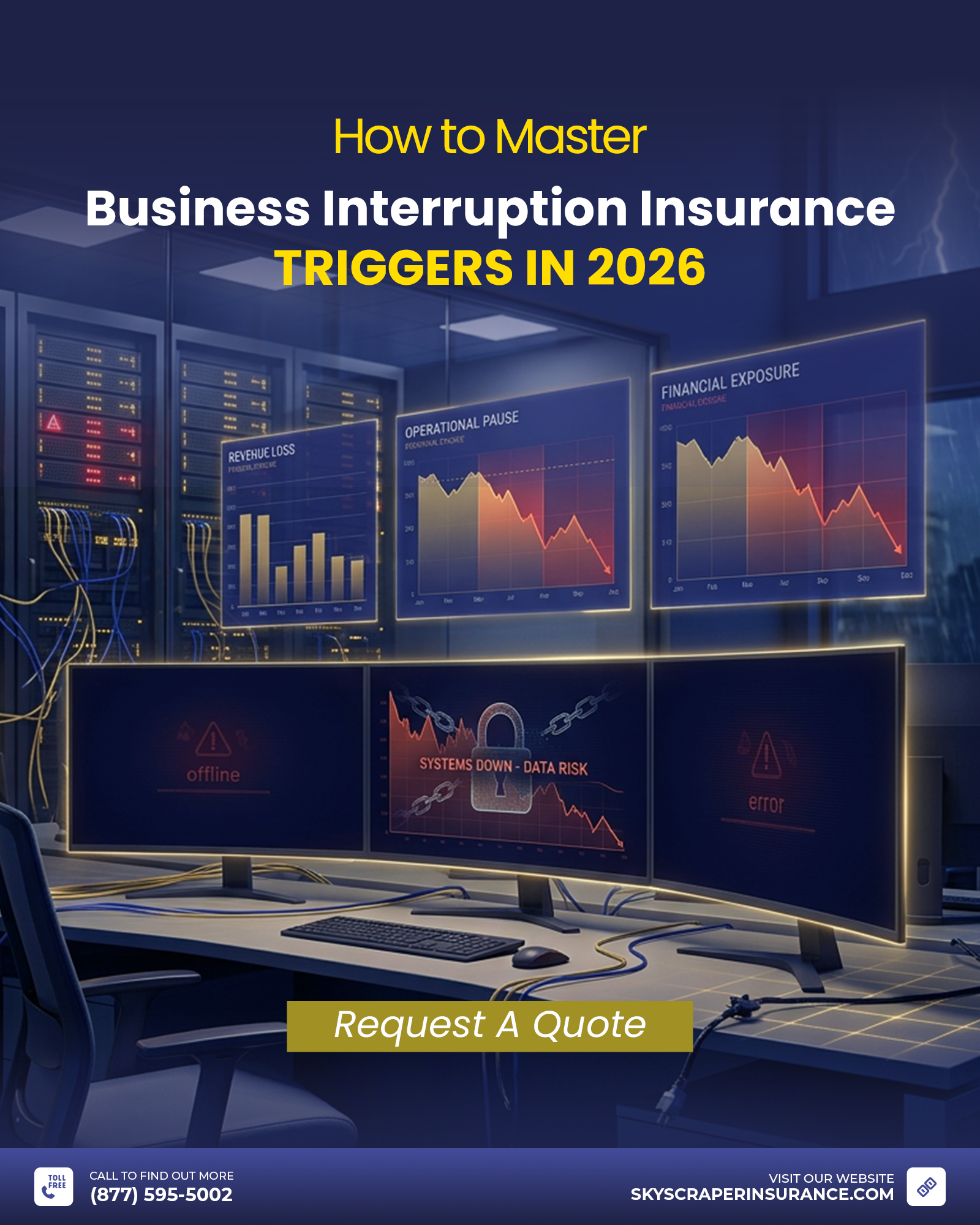
Imagine this: a massive storm rolls through your area, knocking out a regional power substation. For four straight days, your business has no electricity. Your digital systems are dark, your inventory sits in a dead facility, and your revenue drops to zero.
You breathe a sigh of relief knowing you pay a premium every month for Business Interruption (BI) insurance. You submit your claim for lost profits, confident your safety net will catch you.
Two weeks later, the letter from the carrier arrives: Claim Denied.
At Skyscraper Insurance, we review hundreds of commercial property policies every year, and this is the most common heartbreak we witness. Business Interruption is easily the most misunderstood policy in the commercial market. Many owners view it as an all-encompassing “income safety net.”
The hard reality of 2026 is that BI insurance is highly restrictive. It doesn’t simply cover a drop in revenue; it requires a highly specific sequence of events to activate. If you don’t understand your coverage triggers before a crisis hits, you are paying for an illusion of security.
Here is exactly why BI claims get denied, how the triggers work, and how to fix your exposure.
1. The Golden Rule: Direct Physical Loss or Damage
The single biggest reason Business Interruption claims are denied comes down to a fundamental insurance law: BI is not a standalone policy; it is an extension of your Commercial Property coverage.
To trigger BI coverage, there must be direct physical loss of or damage to property at your insured premises, caused by a covered peril (like fire, wind, or vandalism).
The Separation of Loss:
If a fire breaks out in your server room and melts your infrastructure, forcing you to shut down for a week, your BI will likely trigger. The fire caused physical damage.
However, if a massive cyberattack locks your systems for a week but causes zero physical damage to your hardware, a standard BI policy will deny the claim. No physical dirt, bricks, or wires were broken.
This is exactly why businesses that lost revenue due to supply chain backlogs, economic inflation, or public health closures historically saw their claims denied—there was no physical damage to the structure itself.
2. The Civil Authority Trap
“But what if the damage isn’t to my building, but the police close my street?”
This brings us to the Civil Authority Endorsement. This extension is designed to cover lost income when a government entity prohibits access to your business due to damage elsewhere. But carriers look for very specific fine print to deny these claims:
- The Proximity Requirement: The physical damage that caused the government closure must usually be within a strict radius of your front door (often 1 to 5 miles).
- The Cause of Access Prohibition: The closure must be a direct result of physical damage to neighboring structures, not just a precautionary measure. If the city shuts your street down for a routine parade or a non-damage security protocol, your BI policy remains dark.
The BI Activation Matrix: Triggers vs. Denials
To help your operations team audit your true exposure, review the comparison below of common business disruptions and how carriers evaluate them:
| Disruption Scenario | The Carrier’s Verdict | Why It Gets Denied or Approved |
| A fire destroys your main warehouse, stopping all shipping. | Approved ✓ | Direct physical damage by a covered peril directly caused the income suspension. |
| A regional utility outage cuts your power for 72 hours. | Denied ✗ | Standard BI excludes off-premises utility failure unless a specific Utility Services endorsement is purchased. |
| Your primary supplier suffers a factory flood, halting your assembly line. | Denied ✗ | The damage happened at their property, not yours. (Requires Contingent Business Interruption coverage). |
| An key employee quits, causing you to lose a major corporate client. | Denied ✗ | Financial loss caused by personnel issues lacks the mandatory “physical damage” trigger. |
3. The “Waiting Period” Deductible
Unlike standard property insurance, which uses a dollar deductible (e.g., $5,000), Business Interruption insurance often uses a Time Deductible, commonly known as a Waiting Period.
In most standard 2026 policies, the standard waiting period is 72 hours. This means your business must be completely or partially offline for more than three full days before the insurance carrier owes you a single dollar. If your team works around the clock to get your storefront back online in 48 hours, your lost revenue during those two days is completely unrecoverable under a standard policy form.
Take Control: Schedule a BI Coverage Review
A crisis shouldn’t be the moment you discover your policy language has left you stranded. Managing your risk isn’t about hoping disasters don’t happen; it’s about engineering your policies so they respond exactly when your revenue stops.
At Skyscraper Insurance, we practice forensic policy auditing. We look past the top-line numbers on your declaration page to find the exclusions, endorsements, and waiting periods that actually dictate your survival. We help you secure critical add-ons like Contingent Business Interruption (for supplier failures) and Off-Premises Utility extensions so your safety net actually matches your real-world dependencies.
Are you certain your income stream is secured, or are you operating under a false sense of coverage?
Don’t wait for a denial letter to read the fine print. Reach out to our specialized advisory team today for a comprehensive BI coverage review. We will stress-test your business continuity plan against your current policy triggers and ensure your cash flow remains unbroken through any disruption.