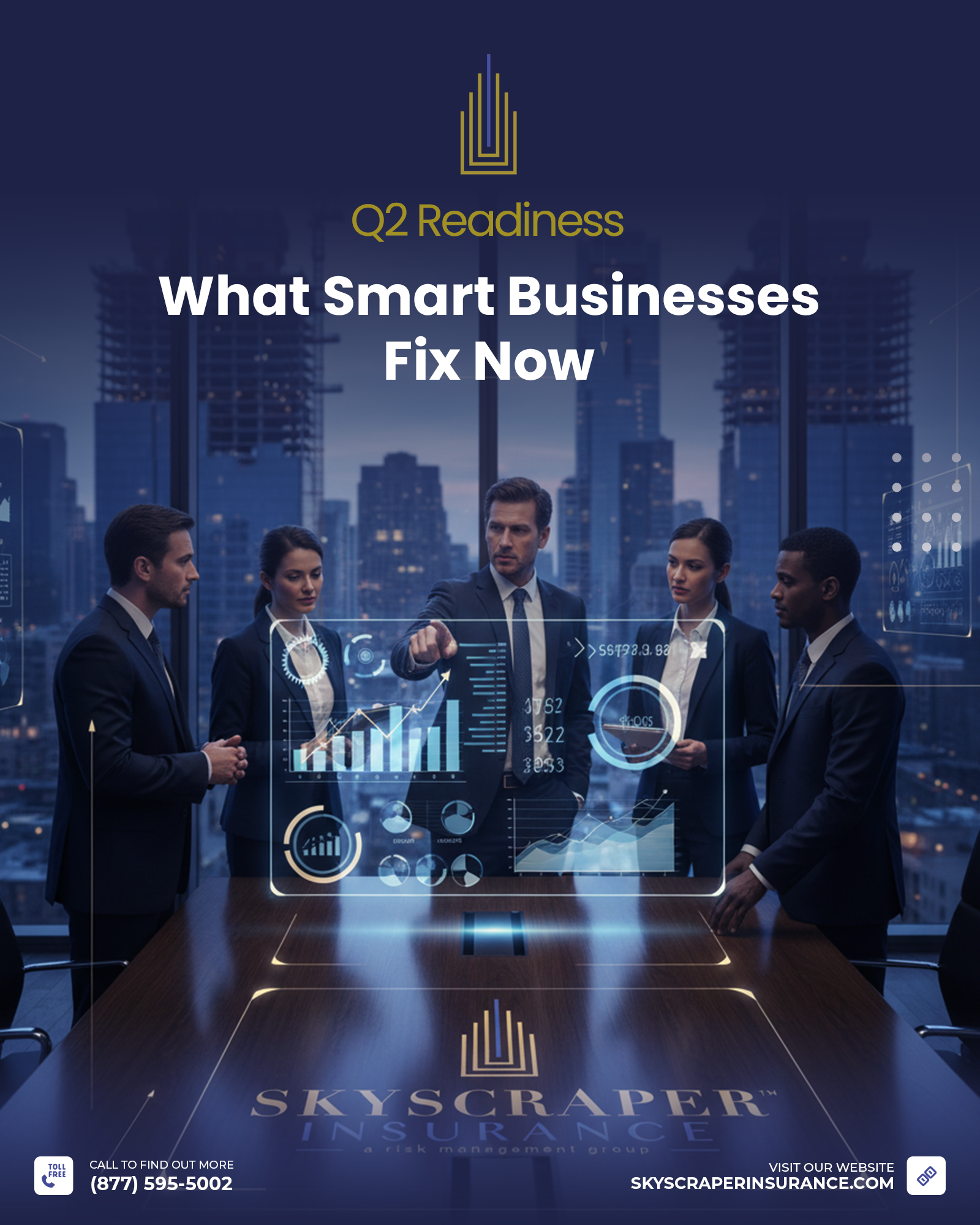
The transition from the first quarter to the second is more than just a page-turn on the calendar. In the world of commercial risk, April 1st represents a significant “re-baselining.” If Q1 was about surviving the winter and finalizing last year’s books, Q2 is the season of deployment. It is when projects break ground, inventory arrives for the summer rush, and hiring typically accelerates.
However, “Smart Businesses” know that scaling without auditing is a recipe for disaster. At Skyscraper Insurance, we’ve observed a consistent pattern: the most successful enterprises are the ones that spend the final weeks of March “fixing” their foundations. They don’t wait for a catastrophic claim or a punishing year-end audit to realize their coverage is out of alignment. They make final adjustments now to ensure their Q2 growth is protected.
1. The Payroll & Revenue “Success Surcharge”
One of the most common mistakes businesses make is staying tethered to the estimates they provided back in January. Most commercial insurance—specifically General Liability and Workers’ Compensation—is “auditable.” This means you pay based on what you think you will earn or pay in salary.
If your Q1 was exceptionally strong, your 1.1 projections are likely already obsolete. If you don’t adjust your “Estimated Annual Payroll” or “Estimated Gross Revenue” now, you are essentially deferring a massive bill. When the carrier conducts their audit next year, they will hit you with a “Success Surcharge”—a lump-sum premium adjustment that can devastate your cash flow. Fixing these numbers before April allows you to pay the correct, pro-rated amount as you earn it.
2. The Inflation Gap: Revisiting Your Statement of Values
If you haven’t looked at your Property Insurance limits in the last six months, you are almost certainly underinsured. Inflation has fundamentally changed the “Replacement Cost” of specialized machinery, electronics, and construction materials.
If your policy is based on what it cost to build your facility or buy your equipment in 2022, you are likely sitting on a 15% to 20% valuation gap. In the event of a total loss, the insurance company will apply a “Co-Insurance Penalty” if you haven’t insured your assets to at least 80% or 90% of their actual current replacement value. Smart businesses use the lead-up to Q2 to update their Statement of Values (SOV) to reflect today’s market reality, not yesterday’s receipts.
3. Vendor Compliance: The COI Audit
Spring is the peak season for third-party vendors landscapers, HVAC technicians, and exterior contractors. Does your business have a rigorous process for collecting and verifying Certificates of Insurance (COIs)?
A handshake agreement or a PDF from three years ago isn’t enough. If a sub-contractor’s insurance has lapsed and they cause a fire or an injury on your premises, that liability flows directly up to your policy. Before you kick off Q2 projects, conduct a “Compliance Sweep.” Ensure every vendor has an active policy that names you as an Additional Insured. This is the single most effective way to transfer risk and protect your own loss history.
Q2 Risk Management Matrix: Fixed vs. Flawed
To help you identify your own blind spots, review the following comparison between a standard “Reactive” approach and the “Smart Business” approach to Q2 readiness.
| Risk Category | The Flawed (Reactive) Approach | The Smart (Proactive) Fix | Q2 Outcome |
| Workers’ Comp | Waiting for the year-end audit. | Adjusting payroll to match hiring. | Predictable cash flow; no audit shock. |
| Property | Insuring at “Book Value.” | Updating to “Replacement Cost.” | Full recovery after a catastrophic loss. |
| Vendor Risk | Assuming the vendor is covered. | Mandatory COI verification sweep. | Liability stays with the third party. |
| Cyber Risk | “IT handled it in January.” | Employee phishing simulation. | Blocks high-volume Q2 social engineering. |
| Fleet / Auto | Adding vehicles only at renewal. | Real-time scheduled asset updates. | Immediate coverage; no “unlisted” denials. |
The Digital Front: Post-Tax Season Hygiene
Cybercriminals love the start of Q2. Why? Because businesses have just finished the chaotic tax season, often leaving behind a trail of sensitive digital breadcrumbs. Furthermore, the hiring surge in April brings in new employees who haven’t yet been trained on your specific security protocols.
Smart businesses use this window to run a “Cyber Hygiene” check. This includes:
- MFA Audit: Ensuring Multi-Factor Authentication is active on every entry point.
- Employee Training: Running a phishing simulation for the new “Spring Class” of hires.
- Backup Verification: Testing that your “Off-Site” backups actually work. If a ransomware attack hits in May, “we thought the backup was running” is an expensive sentence to utter.
The Strategic Value of Risk Management
At Skyscraper Insurance, we believe that insurance should be the last line of defense, not the first. True business resilience comes from Risk Management—the active process of identifying and neutralizing threats before they ever become claims.
As you prepare your Q2 executive summary, don’t just look at the sales pipeline. Look at the foundation. Are your contracts current? Are your limits adequate for your new revenue tier? Are your vendors compliant? Fixing these issues now, while the quarter is still young, is what separates the companies that scale from the companies that stumble.
Don’t leave your Q2 success to chance. The complexity of modern business requires more than a “set it and forget it” policy. It requires a partner who shares your vision for growth and understands the hurdles in your path.
Take control of your risk today. Reach out to our expert team at Skyscraper Insurance to schedule a comprehensive Risk Management audit. We will help you find the gaps, fix the numbers, and ensure that your business is fully optimized for the growth ahead.
Skyscraper Insurance: We Share Your Vision for a Better Tomorrow!