When disaster strikes your commercial property, your immediate focus is naturally on safety, emergency mitigation, and keeping your team secure. But once the fire is out or the water is extracted, a secondary, often deeply frustrating crisis begins: the agonizingly slow commercial insurance claims process. For competitive businesses operating in fast-paced markets like New York, every single day spent waiting for a settlement check translates directly into lost revenue, compromised client relationships, and mounting operational stress.
Many business owners assume that delays are simply an unavoidable part of dealing with insurance carriers. However, the secret to bypassing months of bureaucratic gridlock isn’t having the most expensive policy on the market—it’s having the right paperwork perfectly organized before the adjuster even picks up the phone. At Skyscraper Insurance, we know from years of experience that better prep equals faster payouts.
Understanding the Adjuster’s Mandate
To speed up settlements, you must first understand what the insurance adjuster is actually trying to accomplish. They aren’t requesting endless paperwork just to intentionally frustrate you. Adjusters are strictly bound by corporate compliance, state regulations, and rigorous internal auditing standards. Their professional mandate is to verify the exact cause of the loss, confirm the incident falls under your active coverage, and quantify the financial damages with absolute empirical evidence.
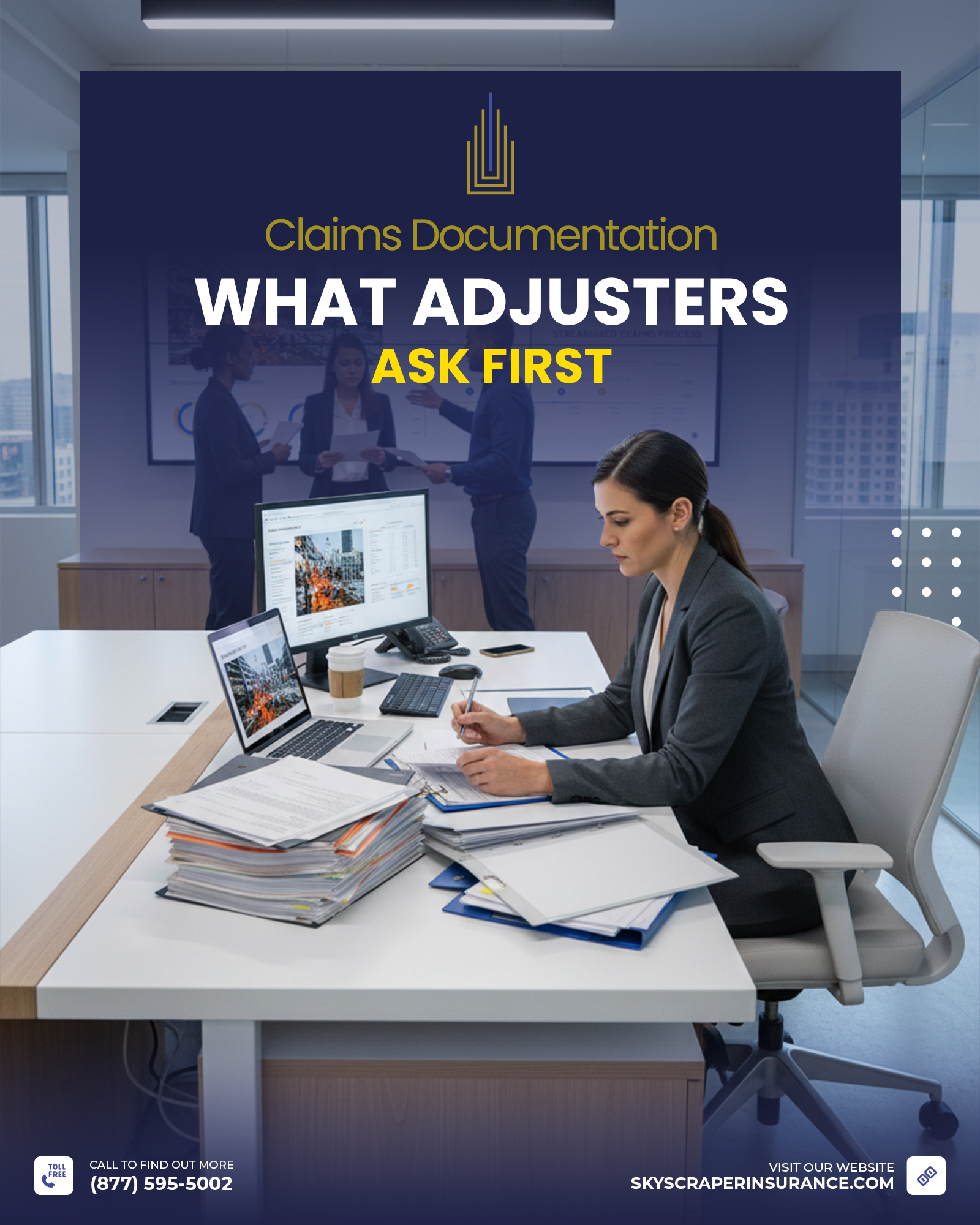
If you hand an adjuster a chaotic, unorganized shoebox full of wet receipts or send them thirty fragmented emails, your claim immediately goes to the bottom of their review queue. Conversely, if you hand them a pristine, logically organized claims documentation package, you give them the exact ammunition they need to justify and approve your settlement with their superiors immediately.
The Critical “First Asks”: Visual and Mitigation Evidence
So, what exactly do adjusters ask for first? The immediate priority is establishing the precise scope and origin of the physical damage. Before you even think about cleaning up non-hazardous debris or throwing away ruined inventory, you must capture undeniable visual proof.
Adjusters will immediately ask for high-resolution, time-stamped photos and videos of the damage. They want to see the exact source of the problem (e.g., the burst plumbing fixture, the collapsed roofing section, or the point of forced entry) as well as wide-angle shots of the surrounding affected areas. Next, they will ask for your emergency mitigation invoices. If you hired a 24/7 water extraction team to prevent further mold growth, or a board-up service to secure broken windows, the adjuster needs those contracts and work orders to prove you actively fulfilled your policy’s requirement to mitigate further loss.
Proving the Financial Impact: The Second Wave of Requests
Once the physical damage is verified, the adjuster’s focus will shift entirely to the financial quantification of your claim. This is where unprepared businesses face the longest delays. For standard property damage, adjusters will ask for original purchase receipts, detailed asset ledgers, and professional contractor estimates for the repair or replacement of the damaged property.
If your operations were halted and you are filing a Business Interruption claim, the documentation requests become significantly more intense. To calculate your exact lost net income, adjusters will demand historical profit and loss (P&L) statements, your last two years of tax returns, and current payroll records.
The Adjuster’s Priority Checklist
To help you anticipate the carrier’s needs, let’s break down the exact documents adjusters prioritize based on the specific type of commercial claim you are filing:
| Commercial Claim Scenario | What Adjusters Ask First (Immediate Priority) | Why It Accelerates the Settlement |
| Severe Property Damage (Fire, Wind, Water) | Time-stamped photos of the origin point; emergency repair/mitigation invoices. | Proves the cause of loss immediately and confirms you took action to prevent further damage. |
| Business Interruption (Forced Closure) | Utility outage reports or Civil Authority notices; recent Profit & Loss (P&L) statements. | Empirically establishes why operations ceased and establishes the baseline for lost revenue calculations. |
| Commercial Crime / Theft | The official filed police report; security camera footage of the incident. | Carriers rarely move forward on theft claims without formal law enforcement verification of the crime. |
| General Liability (Customer Injury) | Internal incident reports; witness statements; photos of the hazard area. | Helps the carrier determine negligence and establish a legal defense strategy early on. |
Stop Reacting, Start Preparing
The companies that secure the fastest, most comprehensive settlements do not scramble to find these documents after a catastrophe occurs. They maintain secure, cloud-based, off-site backups of their asset inventories and financial records year-round. They proactively structure their documentation so that when the adjuster asks a question, the answer is already sitting in their inbox.
Don’t let disorganized paperwork dictate the financial survival of your enterprise. At Skyscraper Insurance, our expert brokers are dedicated to helping you build a resilient, proactive risk management strategy that holds up under pressure. Take control of your financial recovery today by ensuring you have exactly what the adjusters want, exactly when they want it.
Are you ready to optimize your disaster response? Reach out to our team for a comprehensive Claims checklist to start organizing your files and schedule a strategic consultation today to ensure that your business is fully prepared for the unexpected.
Skyscraper Insurance: We Share Your Vision for a Better Tomorrow!