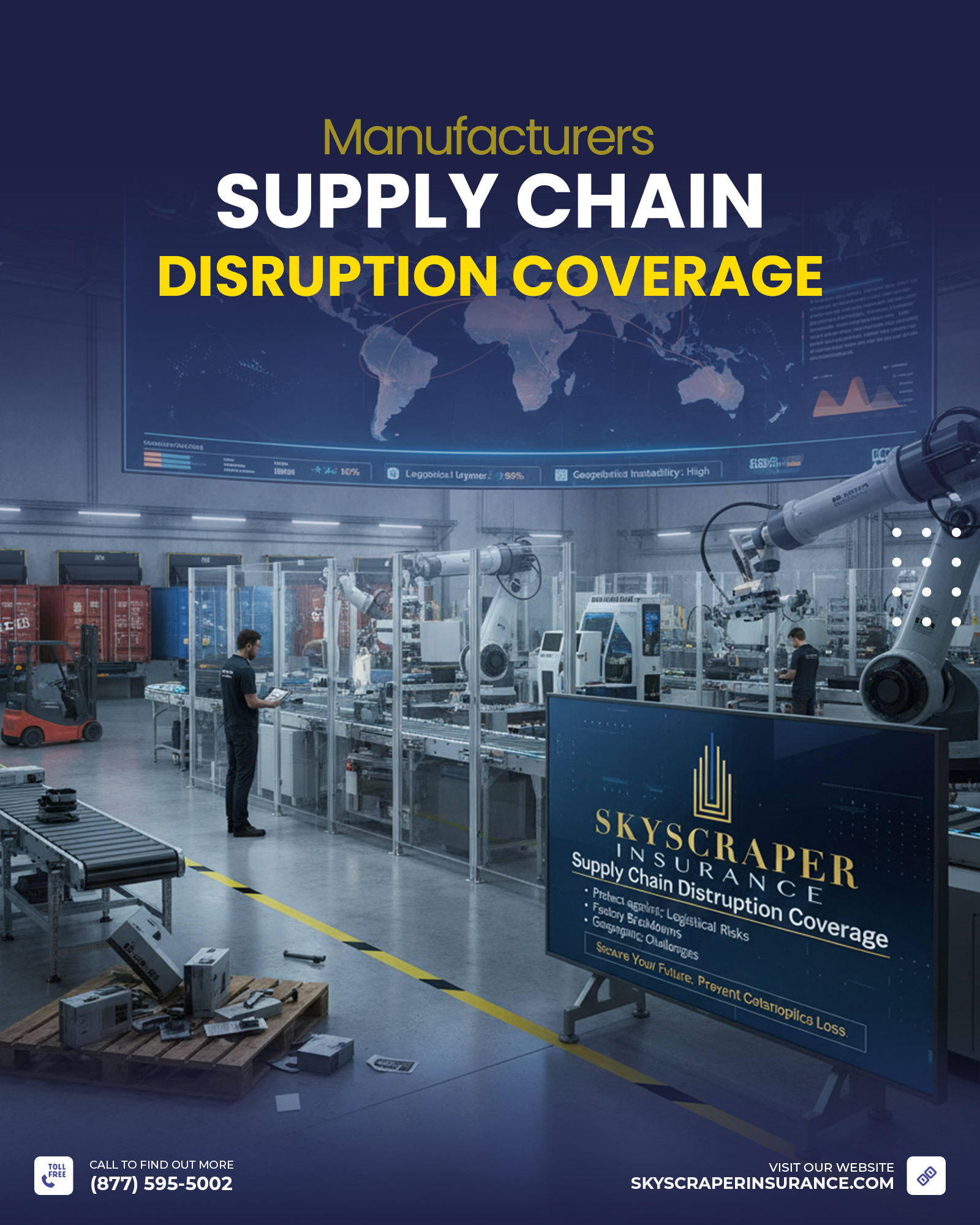
In today’s hyper-connected global economy, manufacturing supply chains are marvels of modern efficiency. Raw materials are sourced from one continent, assembled on another, and shipped to consumer markets worldwide in a matter of days. But that same “just-in-time” efficiency breeds severe vulnerability. A single, isolated bottleneck—a factory fire in Asia, a localized natural disaster, or a sudden logistical failure—can completely halt your domestic production lines.
For manufacturers, the financial fallout of these delays is immediate, compounding, and devastating. You might assume your commercial insurance policy will automatically catch you when the supply chain snaps. Unfortunately, many business owners discover the harsh reality of their coverage limits only after a catastrophic loss. At Skyscraper Insurance, we understand the intricate web of modern manufacturing. Navigating supply chain disruption coverage requires a deep dive into the fine print to understand precisely where your insurance responds—and, more importantly, where it leaves you exposed.
The Core Misconception: Physical Damage vs. Economic Delay
The most common and dangerous misconception among manufacturers is that standard Business Interruption (BI) insurance covers any operational delay. Standard BI is a critical safety net, but it is explicitly designed to replace lost net income only if your physical facility sustains direct physical damage (like a structural fire or a tornado) that forces you to shut down.
However, what happens when your manufacturing facility is perfectly intact, but your sole supplier of a critical electronic component burns to the ground? Because your property wasn’t damaged, your standard Business Interruption policy will not trigger.
Where Insurance Responds: Contingent Business Interruption (CBI)
To protect against third-party disasters, manufacturers need a highly specific endorsement known as Contingent Business Interruption (CBI) coverage. CBI is specifically designed to reimburse your lost profits and extra expenses resulting from an interruption of business at the premises of a customer or supplier.
But there is a massive legal caveat: CBI almost universally requires direct physical loss or damage at the supplier’s or customer’s location, and it must be caused by a peril covered under your own policy.
- Direct Suppliers (Upstream): If a hurricane destroys the factory that manufactures your primary raw materials, CBI can step in to cover your resulting loss of income while they rebuild.
- Direct Customers (Downstream): If your largest buyer’s warehouse burns down and they cannot accept your finished goods, CBI can respond to replace the lost sales.
- The Tier 1 Trap: It is crucial to note that standard CBI usually only covers your direct (Tier 1) suppliers. If your supplier’s supplier (Tier 2) suffers a fire, standard CBI may not respond unless your broker has negotiated a specialized “indirect supplier” endorsement.
The Danger Zone: Where Insurance DOES NOT Respond
The insurance industry operates on precise definitions. If a supply chain disruption lacks that critical “direct physical damage” trigger, your CBI claim will likely be met with a formal denial. Manufacturers must be acutely aware of these common, uncovered scenarios:
- Port Congestion and Shipping Delays: If your shipping containers are stuck off the coast for three months due to logistical backlogs, customs issues, or labor shortages, there is no physical damage. Insurance will not cover your lost revenue.
- Vendor Bankruptcy or Breach of Contract: If your supplier simply goes out of business, faces financial insolvency, or fails to deliver on time due to poor management, this is considered a standard economic business risk, not an insurable peril.
- Pandemics and Government Shutdowns: Widespread government-mandated closures due to disease outbreaks typically do not trigger CBI, as a virus does not cause structural property damage to a facility.
- Labor Strikes: A strike at a major shipping hub or a supplier’s factory halts production, but because it doesn’t involve the physical destruction of property, it is generally excluded.
Disruption Scenarios: Covered vs. Uncovered
To clarify how these policies operate in the real world, review the breakdown of common manufacturing supply chain threats below:
| Supply Chain Event | Does Insurance Respond? | The Reason Behind the Decision |
| The supplier’s factory was destroyed by a tornado. | YES (Under CBI) | Involves direct physical damage to a dependent property from a covered peril. |
| Supplier goes bankrupt and halts production. | NO | Economic failure and insolvency do not constitute physical property damage. |
| Key components are delayed by a massive port strike. | NO | Logistical delay without direct physical damage is universally excluded. |
| Your main buyer’s facility suffers a severe fire. | YES (Under CBI) | Physical damage to a dependent buyer prevents your ability to sell goods. |
| Global pandemic causes supplier lockdowns. | NO | No direct physical damage to the supplier’s property structure or equipment. |
Close the Gaps Before the Chain Breaks
A broken supply chain shouldn’t mean a broken business. Because the margins in modern manufacturing are incredibly tight, an uninsured disruption can wipe out an entire year of profitability in a matter of weeks. You cannot afford to rely on assumptions or boilerplate policies when it comes to your commercial coverage.
Protect your manufacturing operations with a proactive, data-driven approach to risk management. Our specialized commercial brokers are ready to dissect your supply chain vulnerabilities, audit your current policies, and structure robust Contingent Business Interruption coverage tailored perfectly to your exact global footprint.
Don’t wait for the next global bottleneck to expose the dangerous loopholes in your coverage. Visit us at Skyscraper Insurance today to schedule your comprehensive Supply chain review and secure your operational future.